Science is one of the best subjects for English learners. It’s hands-on, visual and full of words students can see and touch. The trick is to teach the content and the language students need to explain it.
Pair each lesson with one language pattern
Don’t try to teach everything at once. Pick one pattern per lesson and practice it with the science:
- Animal adaptations (Grade 3): nouns and is/are. “Polar bears are white.” “Camouflage is a color that helps an animal hide.”
- Observing nature (Grade 4): subject–verb agreement and sensory words. “The bird sings. The birds sing.”
- Natural resources (Grade 5): verb tenses and fact vs. opinion. “Farmers grew corn. Today, corn is used to make fuel.”
3 strategies that help every science lesson
1. Use illustrated word wall cards. Twelve key words with pictures, on the wall all unit long.
2. Post a sentence frames anchor chart. “I observe ___.” “I think ___ because ___.” Point to it every time a student explains something.
3. Cut, sort and sequence. Matching and sorting pages let beginners show what they know before they can write much.
End with writing
Finish each unit with a short informative or opinion paragraph using the unit’s words and frames. It’s real science writing at their level.
If you want it ready to go
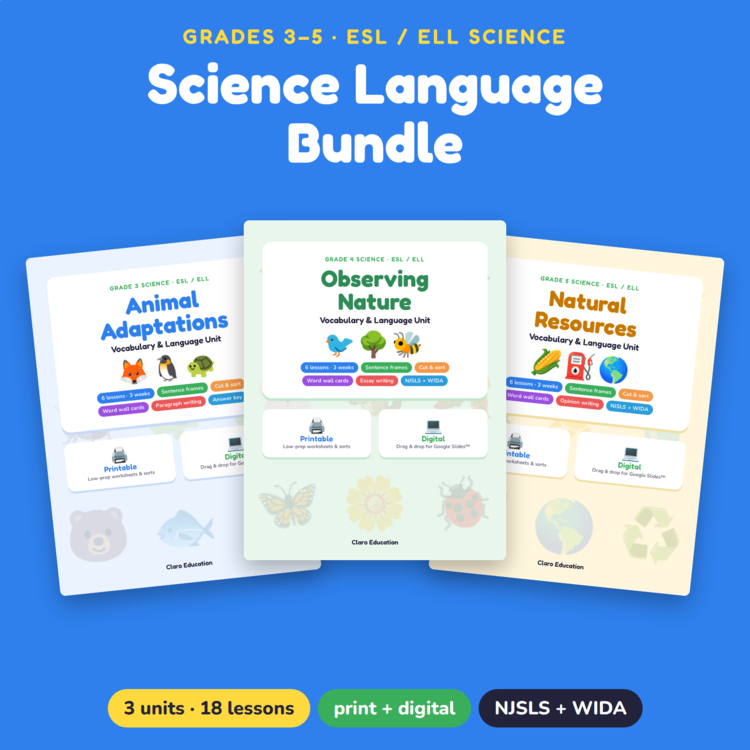
My ESL Science Bundle for Grades 3–5 has three complete 3-week units (Animal Adaptations, Observing Nature, and Natural Resources: Corn & Fuel). Each one has a 25-page printable PDF, 18 digital drag-and-drop slides, a teacher guide, a standards chart, word wall cards, a sentence frames anchor chart and an answer key.


Leave a Reply