
English learners need writing practice that matches how they actually write right now, not a grade-level prompt with “use a dictionary” stapled on. The good news: one prompt can work for a whole class if you level the supports.
Level the supports, not the topic
Give everyone the same picture, chart or short source, then change the scaffolds:
- Levels 1–2: a word bank, a picture for each step and a sentence frame to finish: “First, ___. Next, ___.”
- Levels 3–4: a planning box and linking words (because, so, then).
- Levels 5–6: a length goal and a challenge, like adding a counterclaim.
Everyone writes about the same thing, so you can still share and discuss as a class.
Score what matters with three questions
Instead of one overall grade, look at three things: Is the whole piece organized? (discourse) Are the sentences complete and varied? (sentence) Are the words precise? (word and phrase). Feedback gets much more specific, and students can see how to grow.
Hand students the rubric
“I can” rubrics in kid-friendly language (“I can use because to give a reason”) turn scoring into a goal. Students circle what they did, then pick one thing to try next time.
If you want it ready to go
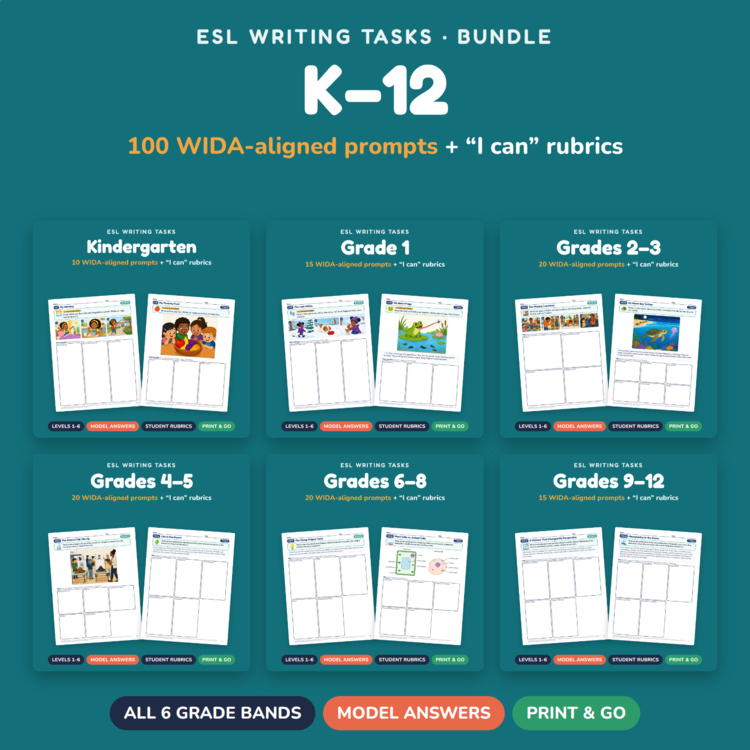
My ESL Writing Prompts K–12 Bundle has 100 original tasks across six grade-band packs (Kindergarten through Grades 9–12), with pictures, charts and short sources, leveled supports for Levels 1–2, 3–4 and 5–6, model answers, teacher pages and student “I can” writing and speaking rubrics. It’s aligned to WIDA’s six proficiency levels and the three dimensions of language (Discourse, Sentence, Word/Phrase), and a K–12 index helps you plan across grades.
Not affiliated with or endorsed by WIDA or the Wisconsin Center for Education Research. WIDA and ACCESS are trademarks of the Board of Regents of the University of Wisconsin System.


Leave a Reply