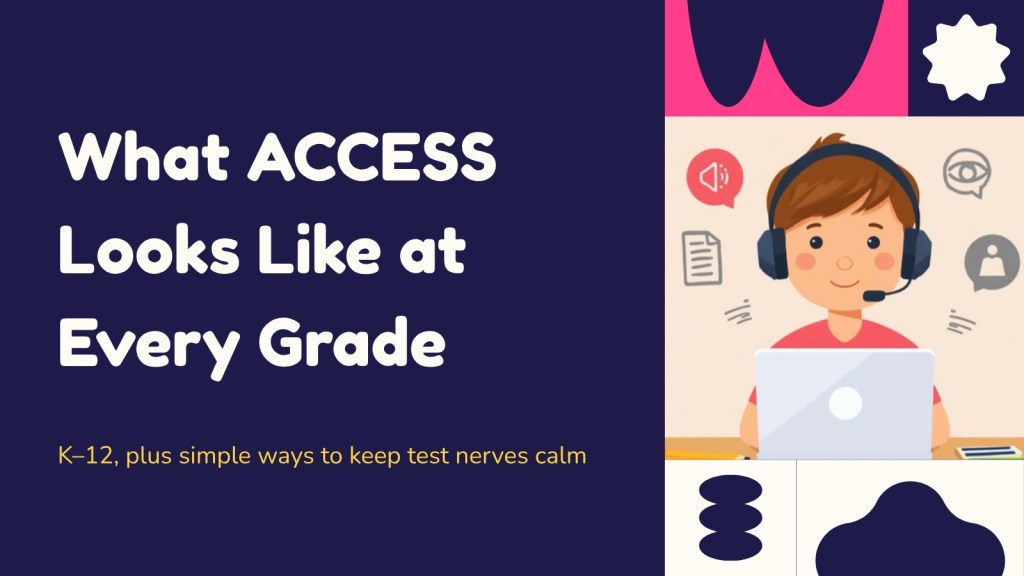
A big test, and a lot of nerves
If you’ve watched a newcomer sit down for ACCESS, whether they’re 6 or 16, you’ve probably seen it: the tight grip on the pencil, the eyes on you instead of the screen. Most of these students know more English than they think. What they don’t know is what’s about to happen.
That’s the part we can fix. English learners do better when the test feels familiar: they know what the screen or booklet will look like, what kinds of questions come, and that it’s okay not to know every answer.
That’s why I’m a big believer in practicing test-style items all year long, not just in the few weeks before testing. To be clear, this isn’t teaching to the test. That’s never the goal. But our ESL students shouldn’t be surprised when they sit down for ACCESS. When the question types already feel familiar, kids stop worrying about the format and get to do what they came to do: show off the language skills they’ve worked so hard to build.
Here’s what ACCESS looks like at each grade, what each part asks students to do, and a few calm-down habits you can start this fall.
What ACCESS looks like, grade by grade
The biggest changes happen between kindergarten and first grade, and again at fourth grade, when Writing moves from paper to the keyboard. Here’s the standard online version for each grade band.
| Grade | How it’s given | What students do | Practice it |
|---|---|---|---|
| Kindergarten | On paper, one-on-one with a trained test administrator | The adult reads everything aloud and records the child’s answers. There are built-in stopping points along the way. | Kindergarten prep |
| Grade 1 | Listening, Reading and Speaking on a computer; Writing in a paper booklet | Listen and read on screen, speak answers into a headset microphone, then write by hand in a booklet. | Grade 1 prep |
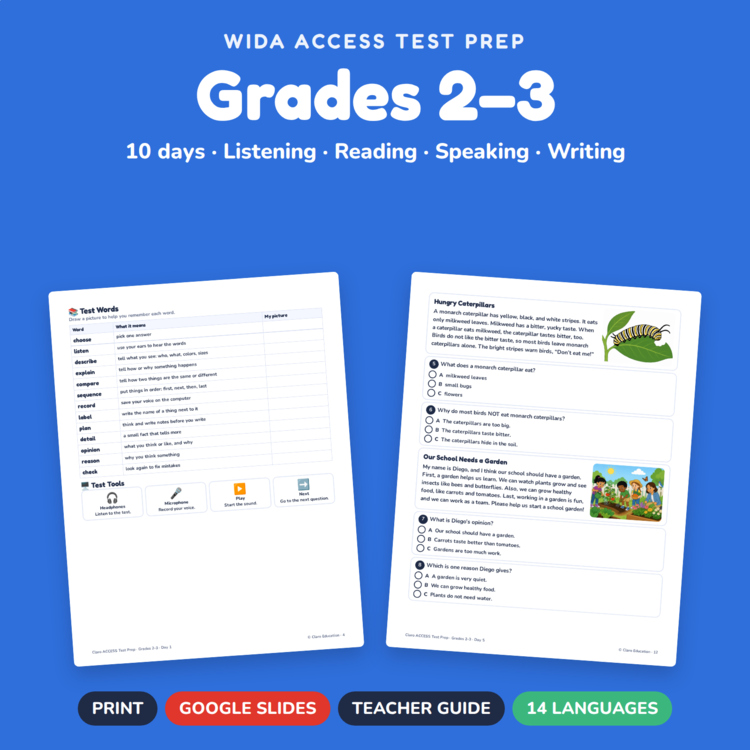
| Grades 2–3 | Listening, Reading and Speaking on a computer; Writing in a paper booklet | Same setup as grade 1, with longer texts and tasks. Writing is always pencil and paper in grades 1–3. | Grades 2–3 prep |
| Grades 4–5 | All four parts on a computer | Writing is typed for the first time, so keyboarding matters. Speaking is recorded through a headset microphone. | Grades 4–5 prep |
| Grades 6–8 | All four parts on a computer | Typed Writing and recorded Speaking, with more academic, content-area topics. | Grades 6–8 prep |
| Grades 9–12 | All four parts on a computer | Typed Writing and recorded Speaking, with the most complex texts and topics. | Grades 9–12 prep |
A few more things worth knowing:
- The online test adapts. Students move to easier or more challenging questions based on how they’re doing, so no two students see exactly the same test.
- Some districts give the whole test on paper, and some states allow handwritten Writing in grades 4–12. Ask your test coordinator which version your students will take.
- WIDA posts free official sample items and online test demos for each grade band. Showing your class the demo on the big screen a few times before test day does a lot to take the mystery out of it.
- Testing windows differ by state, so check your dates with your district.
The four parts, in kid-friendly words
A simple way to explain ACCESS to students, especially younger ones, is as four jobs. Giving each one a simple name and a motion makes it less scary.
- Listening: “ears.” You hear something and choose the answer that matches.
- Reading: “eyes.” You read and show what it means.
- Speaking: “mouth.” You answer out loud. Short answers are okay, and longer ones are even better.
- Writing: “pencil” (or keyboard). You write your ideas. Every word you write shows what you know.
The message for every part is the same: try your best, then keep going. Nobody knows every answer, and that’s built into the test.
Calm-test-nerves habits to start now
None of these take more than five minutes, and they work best when they start months before the test.
- Practice the routine, not just the skills. Set up a few “test-style” mornings: desks apart, quiet voices, headphones on. When the real day looks like a practice day, it’s just another morning.
- Use a speaking ladder. Teach students to climb from a 1-word answer to a 3-word answer to a full sentence of 5 or more words (“dog” → “a big dog” → “I see a big brown dog”). It gives them a plan when they’re asked to talk.
- Practice talking into a headset. From grade 1 up, Speaking answers are recorded. Let students practice speaking to a microphone so it doesn’t feel strange on test day.
- Build keyboarding early. Students start typing their Writing in grade 4. A few minutes of typing practice each week makes a real difference.
- Teach a “stuck” plan. Out loud, together: “I don’t know. I take a breath. I pick my best answer. I keep going.”
- Name the feeling. Let students point to how they feel before a practice session (calm, worried, excited). Anxious kids relax when the feeling has a name and a place to go.
- Bring families in. A short note home in the family’s language explaining what ACCESS is, and that it’s not a pass/fail test for their child, takes pressure off at home too.
- Watch the demo together. Use WIDA’s free online test demo so the screens are familiar before test day.
Want it ready to go?
Start free: my FREE WIDA ACCESS Test Prep Sampler (K–12) is 18 real pages from all six grade-band units (K, 1, 2–3, 4–5, 6–8 and 9–12), covering all four parts: Listening, Reading, Speaking and Writing. It even includes writing models at Levels 1, 3 and 5, so you can try it with your students before you buy anything.
Each full unit is 10 days of short daily practice in all four parts, with prompts you read aloud, a calm-test-nerves page, the 1–3–5 speaking ladder, and family kits in 14 languages. They work on paper or in Google Slides with self-grading Google Forms.
- Kindergarten
- Grade 1
- Grades 2–3
- Grades 4–5
- Grades 6–8
- Grades 9–12
- K–12 Bundle: all 6 grade bands, the best deal if you teach more than one grade or share with your ESL team
Teaching younger newcomers who just arrived? Start with my free Week 1 for K–2: Hello and Names.
Whatever you use, start early and keep it going all year. The goal isn’t a perfect score. It’s a confident kid who walks in, knows what to expect, and shows off everything they can do in English.
Happy (calm) testing,
Veronica
Not affiliated with or endorsed by WIDA or the Wisconsin Center for Education Research. WIDA and ACCESS are trademarks of the Board of Regents of the University of Wisconsin System.


Leave a Reply