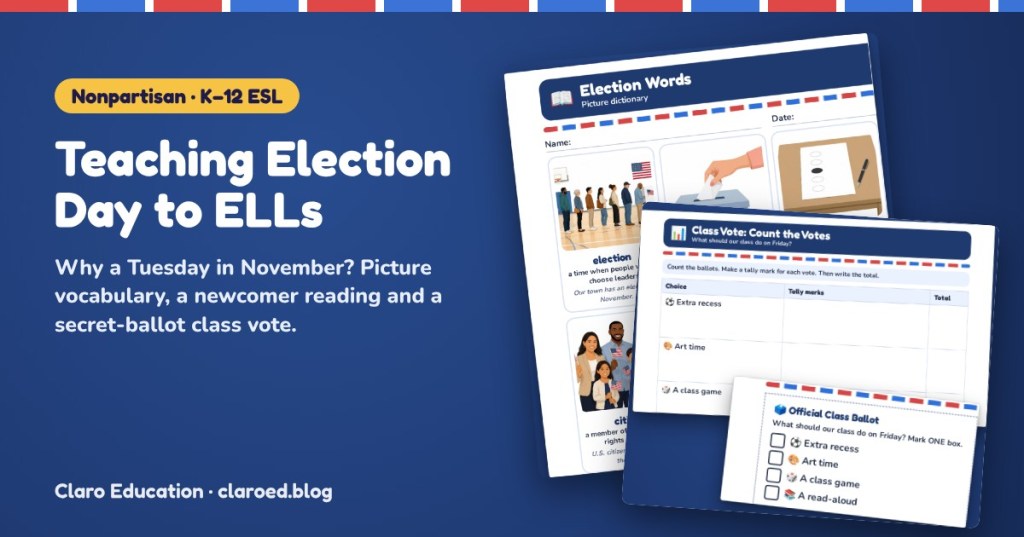
Election Day is Tuesday, November 3, 2026. It’s a midterm year, so you won’t hear about a presidential race, but your students will still see signs, ads, and lines at the polling place. Many of them will have questions.
For English learners, Election Day is a great lesson. The vocabulary is concrete (ballot, vote, count), the history has a clear story, and a class vote gives every student, including your newest newcomer, a real reason to speak.
It can also feel risky. Here is how I teach it so it stays useful, safe, and completely nonpartisan.
First, set the ground rules (for you)
Before you plan anything, decide on these four things:
- No parties, no candidates. We learn how voting works, not who to vote for.
- Never ask how families vote. Don’t ask whether family members can vote, either. Some students’ parents can’t vote yet because of age or citizenship, and immigration status is never a classroom question.
- Everyone votes in our class. I say it out loud: “Everyone can learn about elections, and everyone votes in our class vote.”
- Let students choose whether to share. Elections look different around the world, and some students may have hard memories connected to them. Invite stories about home countries, but don’t require them.
The history: why a Tuesday in November?
This is the hook, and kids and teens love it because the answer is surprising.
In 1845, Congress passed a law that set one day across the country for choosing presidential electors (in other words, for presidential elections): the Tuesday after the first Monday in November. Other federal elections followed later. In 1872, Congress moved House elections to the same day (starting in 1876), and Senate elections joined in 1914, after the 17th Amendment. Historians usually explain the choice of day like this:
- November: Most Americans were farmers. By November the harvest was over, and winter hadn’t started yet, so roads were still open.
- Not Sunday: Many people would not travel on Sunday, their day of rest and church.
- Not Wednesday: Wednesday was market day in many towns.
- Tuesday: Voters often had to travel a long way, sometimes a whole day, to the county seat. Tuesday gave them Monday to travel without missing church or market.
With younger students, keep it to two ideas: Election Day is in November because the farm work was done, and it’s on a Tuesday because people did not travel on Sunday and Wednesday was market day. With middle and high school students, add the 1872 law for House elections and the amendments that expanded the right to vote: the 15th (1870), the 19th (1920), and the 26th (1971, age 18), plus the Voting Rights Act of 1965.
A simple lesson plan (about 60 minutes)
Warm-up (5 min). Show a picture of people waiting in line to vote. Ask: “What are these people doing? Where are they? Why are they waiting?” Give a frame: “I think they are ___ because ___.”
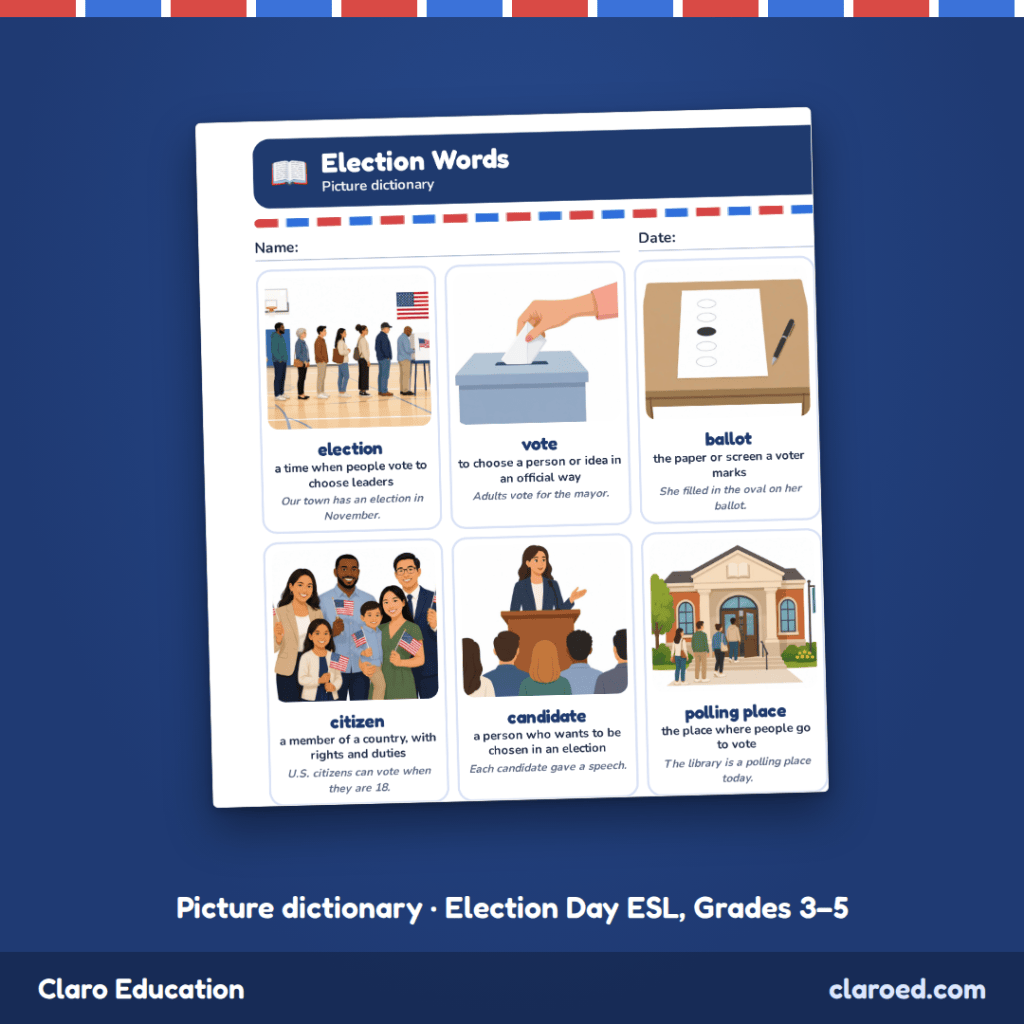
Vocabulary (10 min). Teach 8–12 words with one picture each: election, vote, ballot, voter, citizen, candidate, polling place, register. Students repeat the word, then say a sentence with a partner.
Read (15 min). Read a short history text aloud first, then have partners reread. Stop and ask “Why?” at each reason: Why November? Why Tuesday?
Class vote (5–10 min). See below.
Write (15 min). Students explain why Election Day is a Tuesday in November using frames for their level. Levels 1–2: “Election Day is in ___. It is on a ___.” Levels 3–4: “Election Day is in November because ___.” Level 5: explain two reasons and add an example.
4 tips you can use tomorrow
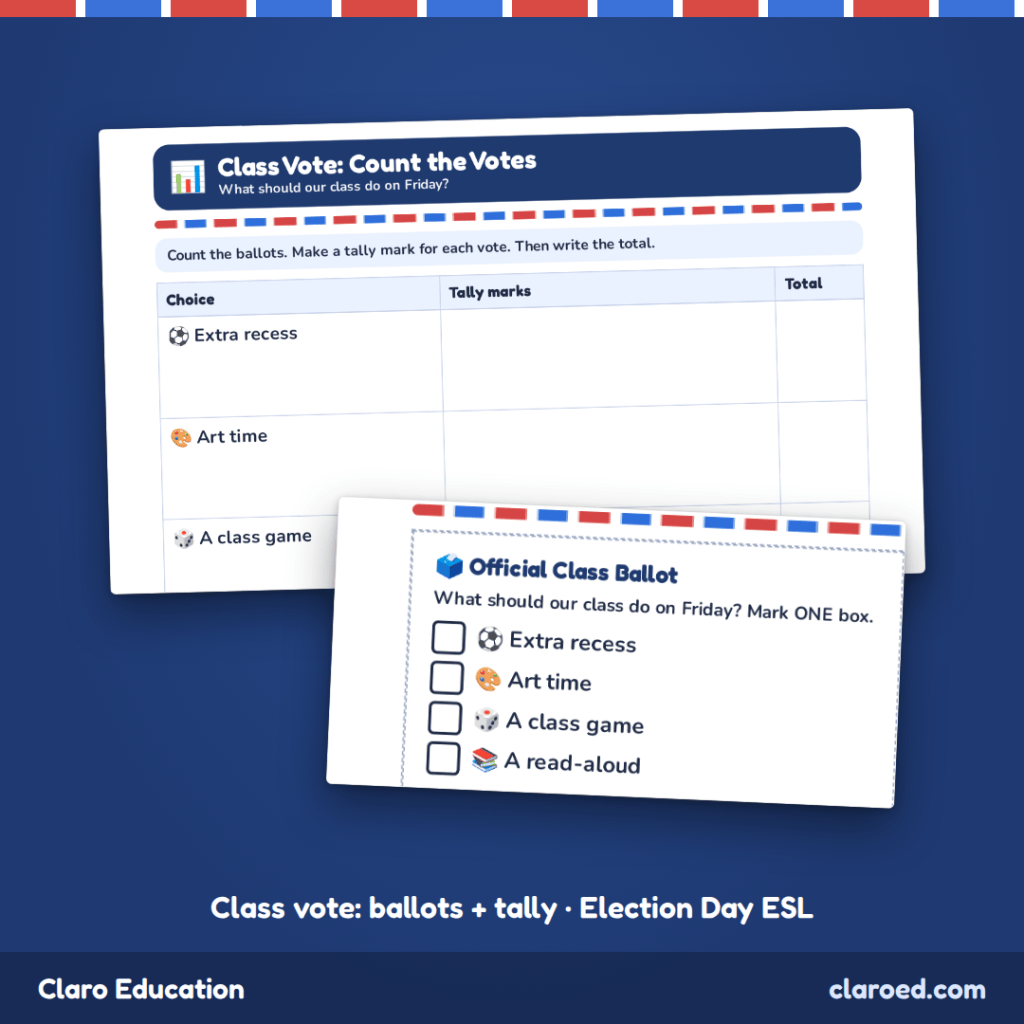
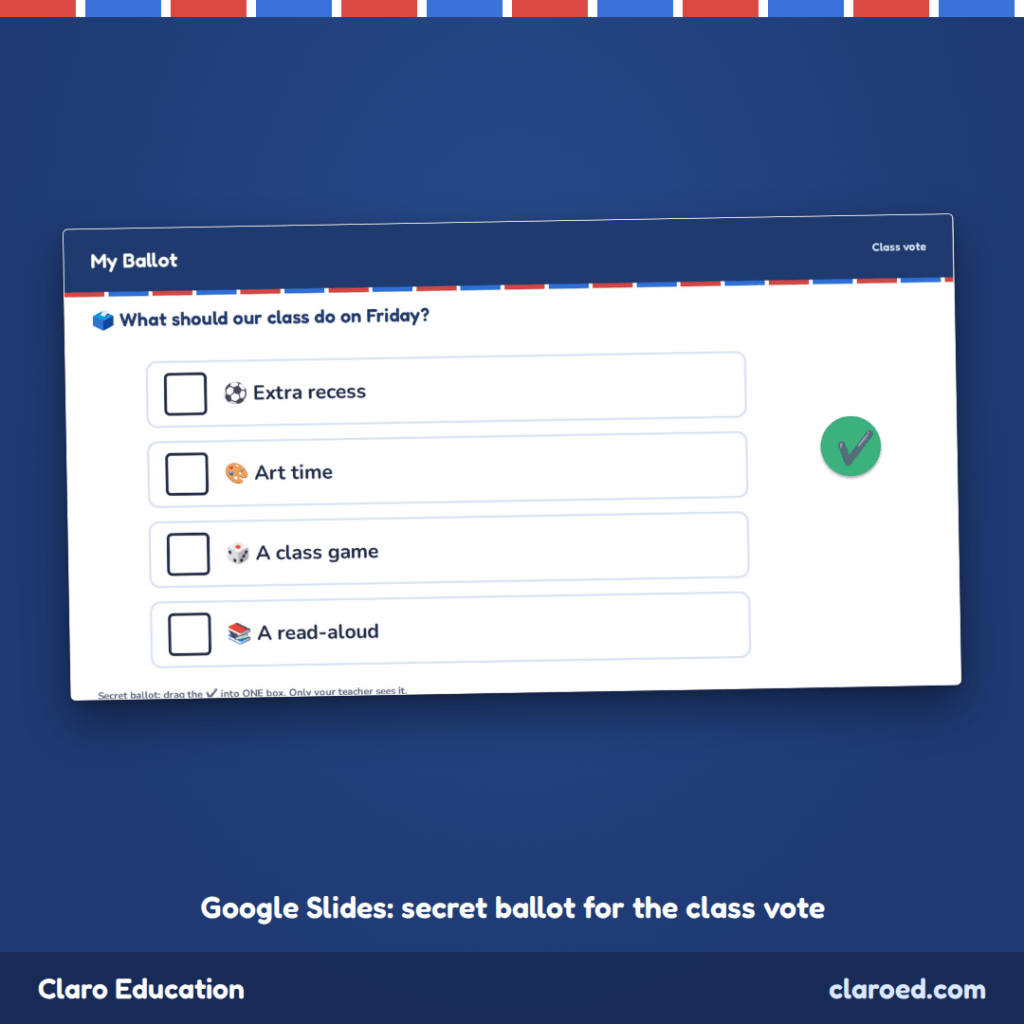
1. Hold a real secret-ballot class vote. Choose a class decision: extra recess, art time, a class game, or a read-aloud. Make small paper ballots with pictures next to each choice. Students vote privately, fold the ballot, and drop it in a box (a tissue box works). Two volunteers count with tally marks. Finish with a frame: “The winner is ___. It got ___ votes.” Then ask: “Why do we use a secret ballot?”
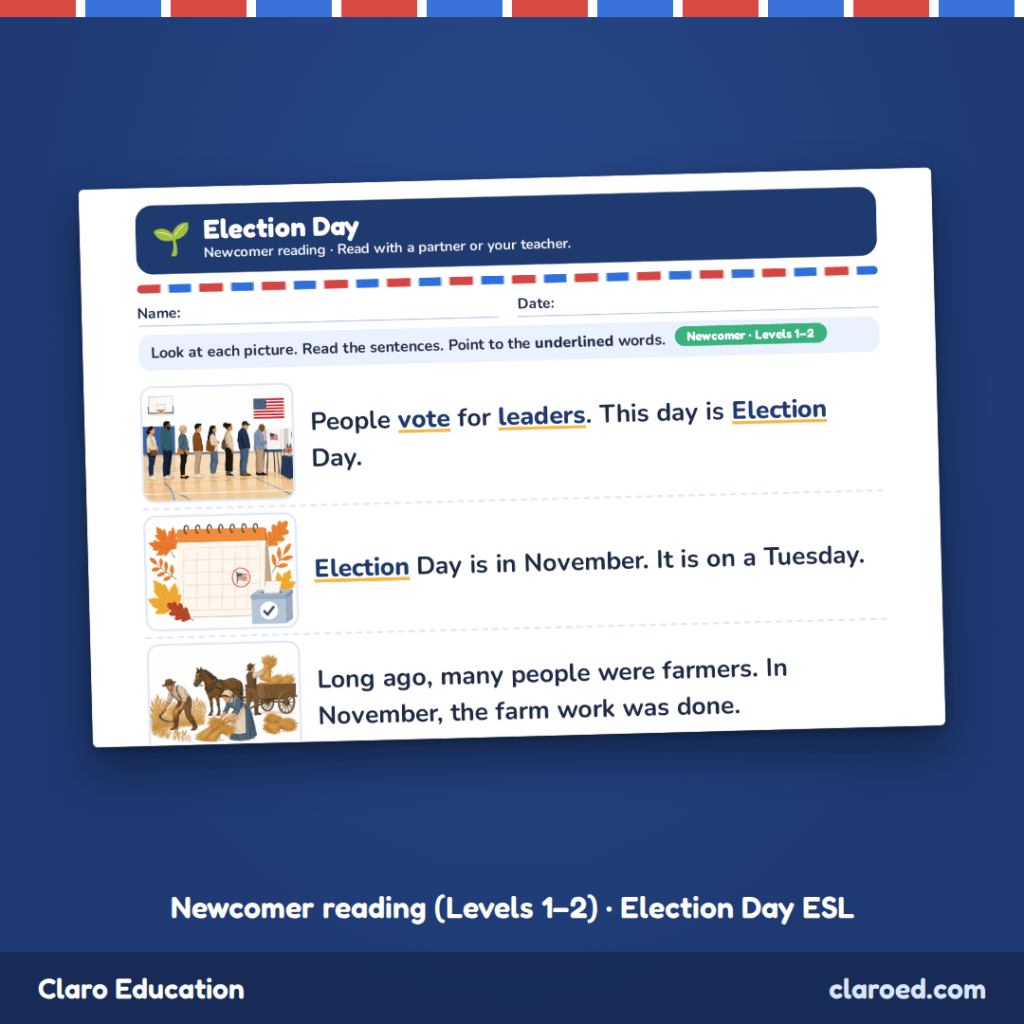
2. Give newcomers the same topic in short sentences. Newcomers can learn this content too. Write six short sentences with a picture each: “People vote for leaders. Election Day is in November. It is on a Tuesday. Long ago, many people were farmers. Today, people vote at a school or a library. They mark a ballot.” Underline the key words. Newcomers point, repeat, and then join the same class vote.
3. Use “because” as your language goal. The whole lesson is about reasons, so it’s a natural place to practice because. Post the frame where everyone can see it and point to it every time a student gives a reason.
4. Make a timeline for older students. Teens can put 1845, 1870, 1872, 1920, 1965, and 1971 on a timeline and write one cause-and-effect sentence for each date. For argument writing, keep the question historical: “Was a Tuesday in November a good choice for voters in 1845?” Students give a claim, two reasons from the reading, and a counterclaim (for example, “Some voters still had to travel a long way.”).
If you want it ready to go
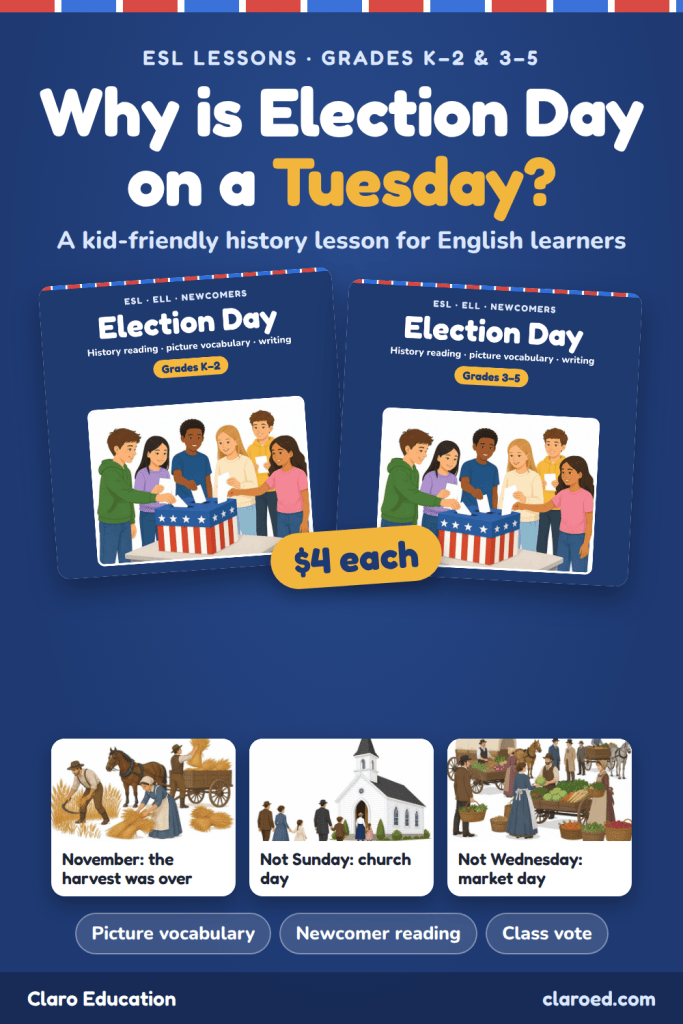
I made Election Day ESL lessons for four grade bands, each with a leveled history reading, picture vocabulary, a newcomer reading for Levels 1–2, comprehension questions with a key, writing frames for every level, printable class ballots and a tally sheet, lesson slides with teacher talk in the speaker notes, and a Google Slides student version. The teacher guide includes notes for keeping the lesson safe and nonpartisan.
- Grades K–2 ($4): an 80-word read-aloud, 8 picture words, draw and write about the class vote
- Grades 3–5 ($4): why Election Day is a Tuesday in November, 10 words, explain the reasons in writing
- Grades 6–8 ($4): the 1845 law, the farmers’ calendar, and the amendments; cause and effect
- Grades 9–12 ($4): from 1845 to the secret ballot and the Voting Rights Act; argument writing
- K–12 Bundle, all four ($12)
Whatever you use, don’t skip the class vote. Counting ballots out loud gives even your quietest newcomer a real reason to say numbers and words in English, and it shows every student how a fair vote works.
Facts in this post were checked with Congressional Research Service reports and Ballotpedia.


Leave a Reply