Veterans Day is Wednesday, November 11. It’s a lovely holiday for English learners: the vocabulary is concrete (veteran, service, thank you, poppy), the history is short, and the main activity, writing a thank-you card, gives every student a real reason to write in English.
It also needs a little care. Some of our students have lived through war, or have family members who serve in other countries’ militaries. Here is how to keep the lesson warm, honest and safe.
Keep the focus on service, thanks and peace
Teach what Veterans Day is (a day to thank people who served in the U.S. military) and why it’s on November 11 (the fighting in World War I stopped on November 11, 1918). Skip combat images and battle details. Students don’t need them to understand the day.
3 ideas you can use this week
1. Pre-teach 8–10 words with pictures. Veteran, serve, military, flag, parade, poppy, remember, thank, peace. Show a picture, say the word, have students repeat it and use it in a sentence: “A veteran served in the military.”
2. Connect to remembrance around the world. Many countries remember on November 11. In the U.K. and Canada it’s Remembrance Day, and people wear red poppies. Ask: “Does your country have a day to remember? What do people do?” Give a frame: “In ___, people ___.”
3. Write thank-you cards at every level. Levels 1–2 copy and complete: “Thank you for your ___.” Levels 3–4 add a reason: “Thank you for ___ because ___.” Levels 5–6 write a short friendly letter. Ask your school office whether a local veterans group would like to receive the cards.
If you want it ready to go
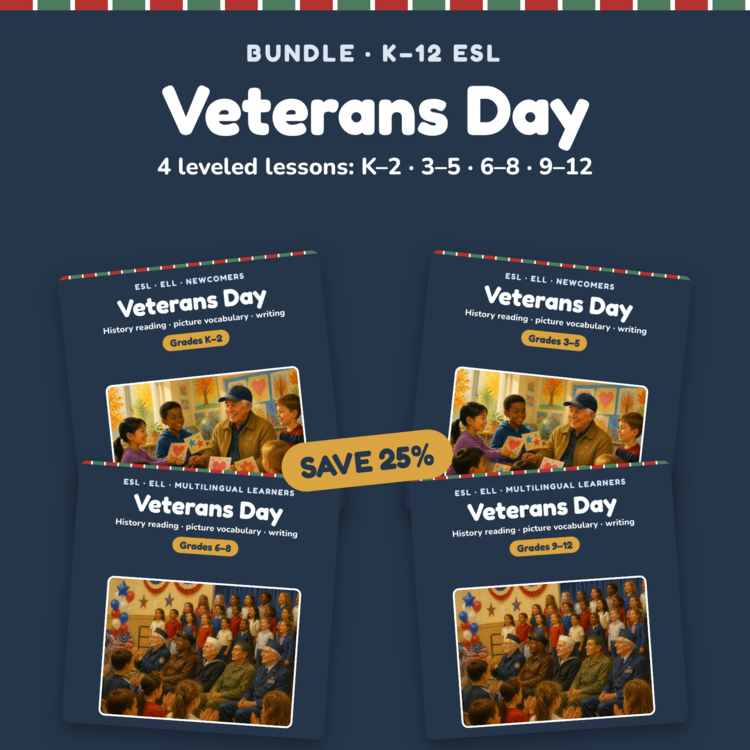
I wrote Veterans Day ESL lessons for four grade bands (K–2, 3–5, 6–8 and 9–12). Each one has a reading written for that age, picture vocabulary, a newcomer reading for Levels 1–2, comprehension questions with a key, a Remembering Around the World page, printable thank-you cards, writing frames for every level, lesson slides and a Google Slides version. The teacher guide includes notes for students who have lived through war.


Leave a Reply