• K–2 Newcomers After Week 1: Classroom Words, Colors, Numbers and Asking for Help

    Your youngest newcomers can say hello and their names. Now what? Weeks 2–5 are about the words they need every single day at school.

    Week by week

    • Week 2: My classroom. “This is a ___.” Chair, table, crayon, book. Label the room together.
    • Week 3: Colors. “It is red.” “What color is it?” Sort crayons, blocks and snacks by color.
    • Week 4: Numbers 1–10. “I have 3 ___.” “How many?” Count everything: friends, pencils, jumps.
    • Week 5: School helpers. Survival English: “May I go to the bathroom?” “I need help.” “I need water.” Plus the people who help: the nurse, the teacher, the principal.

    Make it stick

    Sing it. A short song or chant for each week’s pattern gets stuck in their heads, in a good way.

    Move it. Stand up for red, jump three times, point to the door. Movement helps young learners remember.

    Fade the pictures. Put small pictures above the words in each sentence stem at first, then take them away after a couple of weeks as children learn the words.

    Keep families in the loop

    A family page each week, in the family’s home language, tells parents what their child is learning and how to practice at home.

    If you want it ready to go

    Start with the FREE Week 1: Hello and Names. Then my Newcomer ESL K–2 Unit 1: Weeks 2–5 Bundle has 20 thirty-minute lessons: slides with teacher talk, a Kindergarten workbook and a Grades 1–2 workbook every week, picture cards, song posters, family pages in 14 languages and teacher guides.
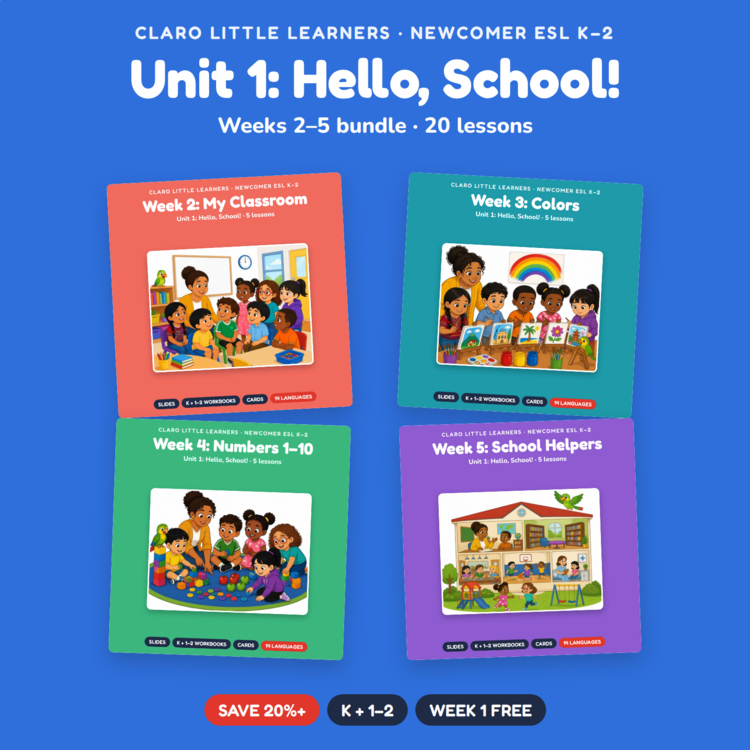
    Cover of Newcomer ESL K–2 Unit 1: Hello, School! Weeks 2–5 by Claro Education
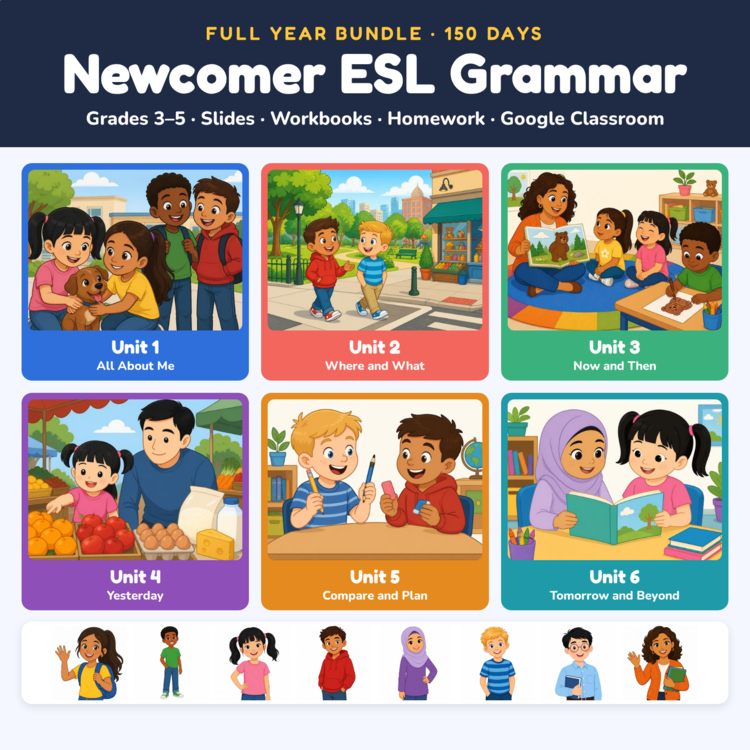
  • A Year of Grammar for Grades 3–5 Newcomers, One Small Step a Day

    Newcomers in grades 3–5 learn fast, but only when the steps are small and the order makes sense. A clear grammar path for the whole year takes the guesswork out of “What do I teach tomorrow?”

    A simple year-long sequence

    1. All about me: pronouns, am/is/are, have/has, plurals
    2. Where and what: prepositions, there is/are, the simple present, can/can’t
    3. Now and then: was/were, the present continuous
    4. Yesterday: the simple past, regular and irregular
    5. Compare and plan: comparatives, going to
    6. Tomorrow and beyond: will, should, because, used to

    Each step uses what students already know, so they’re never lost.

    Try Day 1 tomorrow

    Start with I, you, he and she with am and is. Introduce two characters, then practice:

    • “I am Ana.” “You are Omar.” “He is a student.” “She is a teacher.”

    Students point to a classmate and say a sentence, then write two of their own.

    Use the same characters all year

    When students meet the same characters in every story, they don’t have to learn new names and settings each day. They can focus on the English.

    Teach short forms on purpose

    Wait to teach I’m, isn’t and can’t until students know the full forms, then give each one a mini lesson.

    If you want it ready to go

    Start with the FREE Subject Pronouns lesson (Day 1 of the course). My Newcomer ESL Grammar Full Year Bundle for Grades 3–5 has all 6 units (150 days): weekly slides with speaker notes, a student workbook with quizzes and unit tests, homework pages with a family connection, Google Classroom digital workbooks and teacher guides with answer keys.

    Cover of Newcomer ESL Grammar Full Year Bundle, Grades 3–5 by Claro Education
  • Science for English Learners in Grades 3–5: Content and Language Together

    Science is one of the best subjects for English learners. It’s hands-on, visual and full of words students can see and touch. The trick is to teach the content and the language students need to explain it.

    Pair each lesson with one language pattern

    Don’t try to teach everything at once. Pick one pattern per lesson and practice it with the science:

    • Animal adaptations (Grade 3): nouns and is/are. “Polar bears are white.” “Camouflage is a color that helps an animal hide.”
    • Observing nature (Grade 4): subject–verb agreement and sensory words. “The bird sings. The birds sing.”
    • Natural resources (Grade 5): verb tenses and fact vs. opinion. “Farmers grew corn. Today, corn is used to make fuel.”

    3 strategies that help every science lesson

    1. Use illustrated word wall cards. Twelve key words with pictures, on the wall all unit long.

    2. Post a sentence frames anchor chart. “I observe ___.” “I think ___ because ___.” Point to it every time a student explains something.

    3. Cut, sort and sequence. Matching and sorting pages let beginners show what they know before they can write much.

    End with writing

    Finish each unit with a short informative or opinion paragraph using the unit’s words and frames. It’s real science writing at their level.

    If you want it ready to go

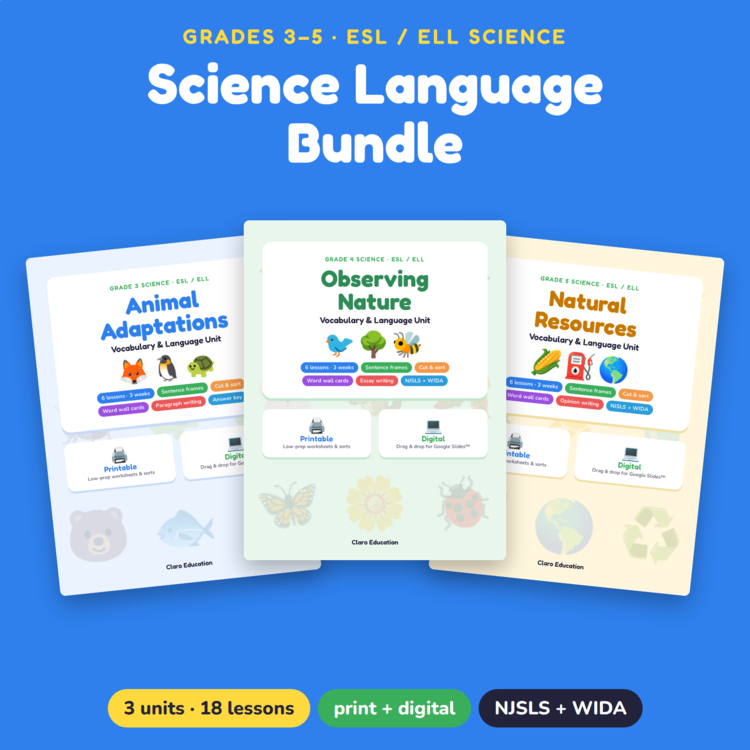
    My ESL Science Bundle for Grades 3–5 has three complete 3-week units (Animal Adaptations, Observing Nature, and Natural Resources: Corn & Fuel). Each one has a 25-page printable PDF, 18 digital drag-and-drop slides, a teacher guide, a standards chart, word wall cards, a sentence frames anchor chart and an answer key.

    Cover of ESL Science Bundle, Grades 3–5 by Claro Education
  • How to Share English Learner Data With Classroom Teachers on One Page

    English language proficiency scores come back, and they’re full of useful information. But for many classroom teachers, a score like “3.4” doesn’t mean much. A one-page student snapshot can change that.

    What to put on one page

    • The student’s name, grade, home language and overall score
    • Scores for all four domains (listening, speaking, reading, writing)
    • What the student can do at their level, in plain words
    • The supports that match their level, for every subject

    Color-code the proficiency levels so a teacher can read it in ten seconds.

    Teach teachers how to read it

    A few minutes in a staff meeting goes a long way:

    • What a score like 3.4 means: the first number is the level, and the second shows progress within it.
    • Look at the lowest domain. A student who speaks well but reads at Level 2 still needs reading support in science and social studies.
    • Match supports to the level. Word banks and visuals for Levels 1–3, sentence starters for higher levels.

    Use it all year

    Share the snapshot at the start of the year, bring it to student support meetings, and update it when new scores arrive.

    If you want it ready to go

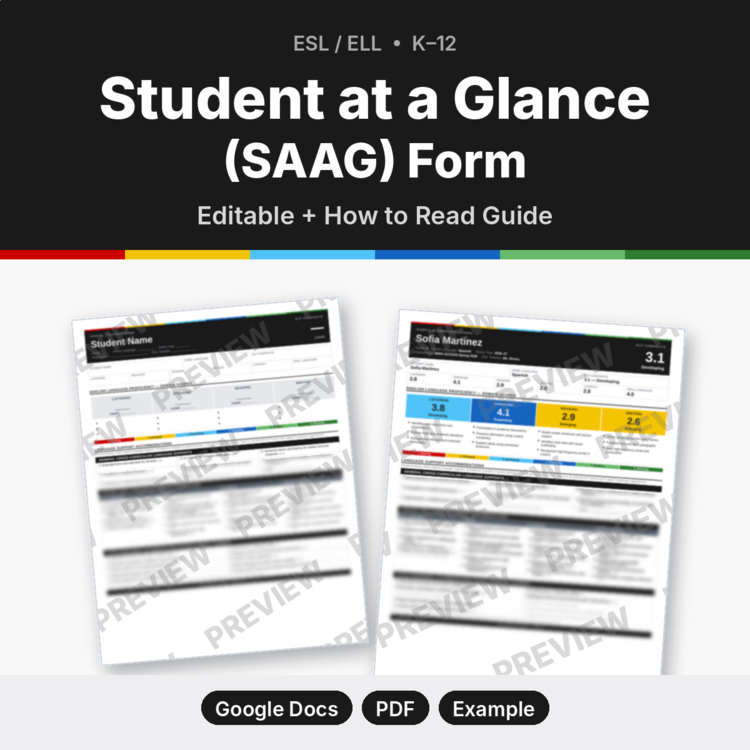
    My ESL Student at a Glance (SAAG) Form is an editable one-page profile (opens in Google Docs or Word) with a score grid, color-coded domain cards for Levels 1–6, accommodations by content area and level tags. It comes with a completed example and a How to Read guide for general education teachers. Official Can Do Descriptor text isn’t included; you add descriptors from your own copies.

    Cover of ESL Student at a Glance (SAAG) Form by Claro Education

    Not affiliated with or endorsed by WIDA or the Wisconsin Center for Education Research. WIDA and ACCESS are trademarks of the Board of Regents of the University of Wisconsin System.

  • Grammar for Adult ESL Beginners: Real-Life English, One Small Step a Day

    Adult English learners come to class after work, after putting kids to bed, sometimes after a long bus ride. They want English they can use tomorrow: at work, at the doctor, at the store and at their children’s school. Grammar can give them that, if it’s tied to real life.

    Teach grammar through grown-up stories

    Start each lesson with a short story about adult classmates in an evening English class. They talk about job skills, rent, the pharmacy and the bus. Learners read it together, then find the grammar inside it. It never feels childish.

    Try this tomorrow: can and can’t for job skills

    Set the scene: a job fair. Learners read about classmates who share their skills, then talk:

    • “I can drive.” “I can’t use a computer yet.”
    • “Can you speak Spanish?” “Yes, I can.” / “No, I can’t.”

    Finish with a real-life task: make a list of three skills to share at a job interview.

    Plan for a multilevel room

    Adult classes almost always mix levels. Give sentence frames and picture support to beginners, and stretch tasks for learners who are ready for more. A short Spanish “I can” statement for each lesson helps many learners see the goal right away.

    Keep the routine short

    About 35–40 minutes of grammar fits inside a 60–120 minute class: Read It, Notice It, Learn It, Look & Say, Practice It, Talk It, Your Turn.

    If you want it ready to go

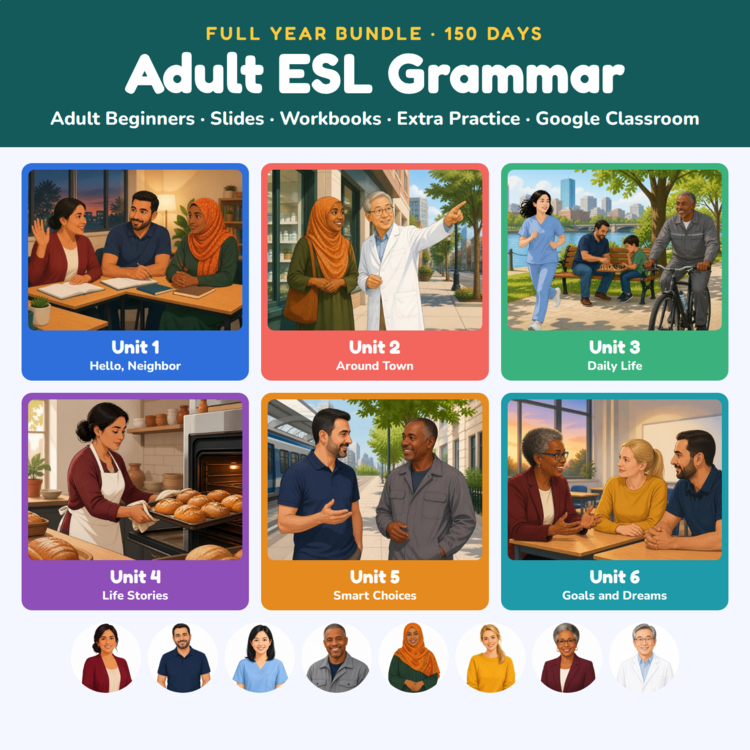
    Try the FREE Can and Can’t for Job Skills lesson first. My Adult ESL Grammar Full Year Bundle has all 6 units (150 days): slides with speaker notes, a student workbook with quizzes and unit tests, Extra Practice pages with a real-life task for every lesson, Google Classroom digital workbooks and teacher guides, with supports for NRS ESL levels 1–4.

    Cover of Adult ESL Grammar Full Year Bundle by Claro Education
  • Survival English Around the School: Cafeteria, Recess, Library and the Nurse

    For a brand-new English learner, some of the hardest parts of the day aren’t in the classroom at all. They’re in the lunch line, on the playground, at the library desk and in the nurse’s office. A few phrases for each place make a huge difference.

    The cafeteria

    Phrases they’ll hear: “Get in line, please.” “Take a tray.” “What is your lunch number?”

    Phrases they need: “Can I have a fork?” “I want milk, please.” “I don’t eat ___.”

    The playground

    Phrases they’ll hear: “It’s time for recess!” “Take turns, please.” “Be safe!”

    Phrases they need: “Can I play?” “Can I have a turn?” “It’s my turn.”

    The school library

    Phrases they’ll hear: “Please use a quiet voice.” “Pick one book.” “Do you have your library card?”

    Phrases they need: “Can I borrow this book?” “Where are the animal books?” “I want a book about ___.”

    The nurse’s office

    Phrases they’ll hear: “How do you feel?” “What hurts?” “Show me where it hurts.”

    Phrases they need: “Can I go to the nurse?” “I don’t feel good.” “My head hurts.”

    How to teach them

    Take a walk to each place and label what you see. Practice the phrases with role-play cards, then let students act it out for real. Hang a labeled poster in the classroom so they can point when the words won’t come.

    If you want it ready to go

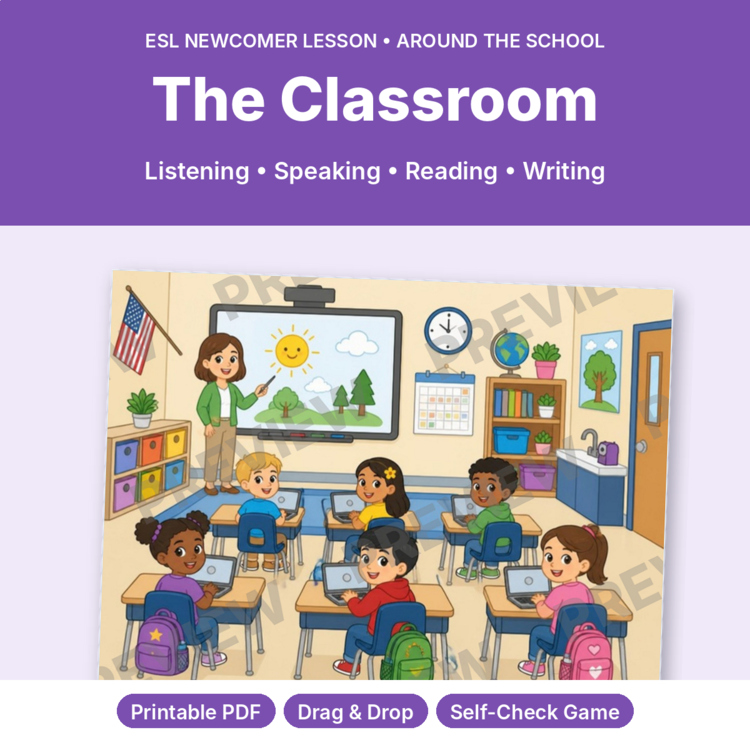
    My Around the School newcomer lessons cover each place in its own lesson: a 3-day plan, a labeled poster, a picture dictionary with a “My language” line, the real phrases adults use, role-play cards, a mini story, writing pages and two Google Slides activities (drag-and-drop plus a self-checking game). Every activity is built for beginning English learners (Levels 1–2).

    Cover of the Cafeteria ESL newcomer lesson by Claro Education

    Pick your lesson on TpT:

  • Teaching Grammar to Middle and High School Newcomers (Without Making It Babyish)

    Teen newcomers have a hard job: learning English from the beginning while sitting in middle or high school classes. Most beginner materials are made for little kids, and teens notice right away. They deserve grammar lessons that respect their age.

    Start every lesson with a story about teens

    A short, illustrated story about teen characters in real school situations (the cafeteria, a group project, a part-time job) gives the grammar a context. Students echo read or partner read first, then go back and notice the grammar in the story.

    Use the same routine every day

    A predictable routine lowers stress and frees up brain space for English:

    Read It (echo or partner read) · Notice It · Learn It · Look & Say · Practice It · Talk It · Your Turn

    About 35–40 minutes is enough. One small grammar step a day adds up fast.

    Teach short forms on purpose

    Teens hear I’m, isn’t and can’t all day. Teach them as their own mini lessons, after the full forms, so students understand what they’re hearing in the hallway.

    Order matters

    Start with be (am, is, are) and subject pronouns, then move to there is/are, the simple present, questions with do/does, can/can’t and so on. A clear sequence means each day builds on the last.

    If you want it ready to go

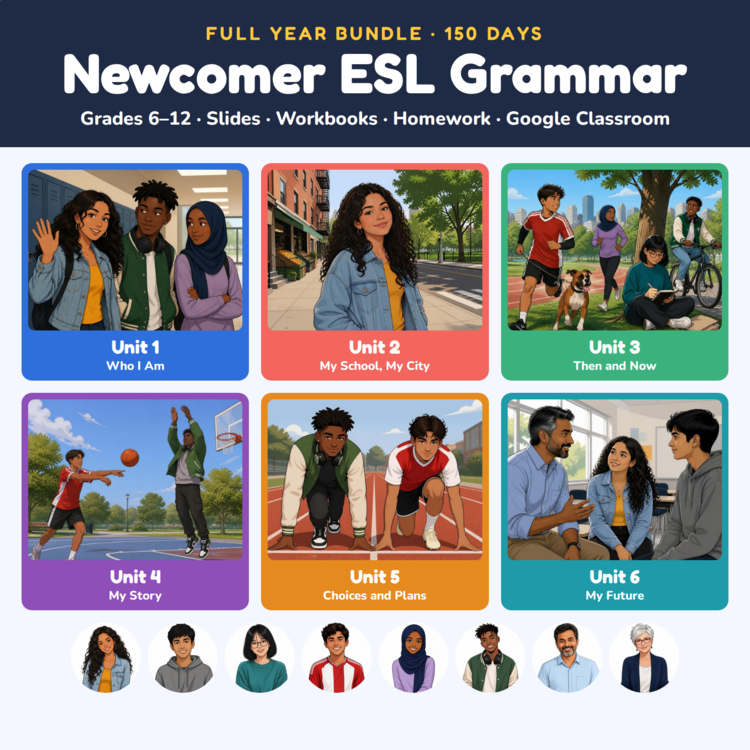
    My Newcomer ESL Grammar Full Year Bundle for Grades 6–12 has all 6 units (150 days): weekly slide decks with speaker notes, a student workbook with quizzes and unit tests, homework pages, Google Classroom digital workbooks and teacher guides with answer keys. Want to try it? The FREE Simple Present lesson for grades 6–12 is in my store.

    Cover of Newcomer ESL Grammar Full Year Bundle, Grades 6–12 by Claro Education
  • Hi there,

    November is a busy month in an ESL room: Election Day, Veterans Day, Thanksgiving, and ACCESS testing getting closer. Here’s everything new from Claro Education to help you plan, including a few free lessons you can use tomorrow.

    November lessons, ready to teach

    Getting ready for ACCESS

    If you teach several grades, one consistent, low-stress routine can get every student ready without a separate plan for each grade. New to the test? Here’s what WIDA ACCESS looks like at every grade.

    For grades 2–3, ACCESS Test Prep Grades 2–3 is 10 days across all four domains, with a speaking day that models answers at levels 1, 3 and 5. Print or Google Slides, $12.

    Free this month

    New in the store

    Coming up on the blog

    Teaching grammar to middle and high school newcomers, survival English around the school, grammar for adult beginners, sharing EL data with classroom teachers on one page, and more. A new post goes up every morning through Oct 28.

    Hit reply and tell me: what’s the one thing your newcomers need most right now? I read every answer, and it shapes what I make next.

    Veronica
    Founder & ESL Curriculum Designer, Claro Education

    Not affiliated with or endorsed by WIDA or the Wisconsin Center for Education Research. WIDA and ACCESS are trademarks of the Board of Regents of the University of Wisconsin System.

  • One ACCESS Test Prep Routine for Every Grade, K–12

    If you teach English learners in several grades, test season can feel like six different jobs. Kindergarten takes the test one-on-one on paper. Grades 1–3 work on screen but write on paper. Older students type. One routine across all of them saves your sanity, and it helps students feel calm.

    I’ve said it before: practicing test-style items through the year isn’t teaching to the test. It means students aren’t surprised on test day, so they can feel confident and show off their language skills.

    A 10-day routine that works at every grade

    • Days 1–2: What the test looks like, and how to stay calm.
    • Days 3–4: Listening: look at the pictures first, then listen.
    • Days 5–6: Reading: find the key words, then check the answer.
    • Days 7–8: Speaking: answer in full sentences, then add more with because.
    • Day 9: Writing: plan, write, then check.
    • Day 10: A mini practice test, with lots of praise.

    Each lesson follows I do, We do, You do, so students see a model before they try.

    Match the format to the age

    Let Kindergarten point, talk and draw while you record. Give Grades 1–3 practice screens for listening and reading, with writing on paper. Give Grades 4–12 typed writing and longer academic passages. And keep the tone respectful for teens.

    Bring families in

    Families feel better when they know what the test is. A short letter and a “What is the ACCESS test?” page in their language goes a long way.

    If you want it ready to go

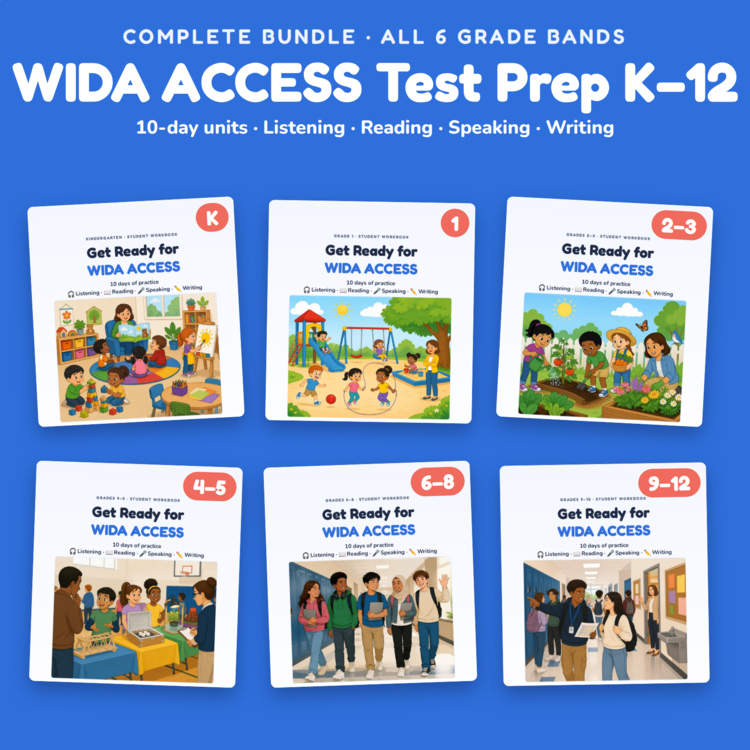
    My WIDA ACCESS Test Prep K–12 Bundle has all six grade-band units (Kindergarten, Grade 1, Grades 2–3, 4–5, 6–8 and 9–12). Each is a full 10-day unit with a teacher guide, slides, a printable workbook, digital practice, Google Forms quizzes (Grades 1–12) and family kits. All items are original and are for practice and familiarity, not to predict scores. Want to try it first? The FREE sampler has 18 real pages from all six units.

    Cover of WIDA ACCESS Test Prep K–12 Bundle by Claro Education

    Not affiliated with or endorsed by WIDA or the Wisconsin Center for Education Research. WIDA and ACCESS are trademarks of the Board of Regents of the University of Wisconsin System.

  • Fall Grammar Lessons for Grades 3–5 Newcomers: There Is, Comparatives and Going To

    Seasonal lessons for older newcomers are often just vocabulary lists. But fall is a perfect time to teach real grammar, because the topics are fun and the pictures do half the work.

    3 fall grammar lessons

    1. Fall is here: there is / there are. Show a fall scene and ask, “What do you see?” Teach the pattern: “There is a scarecrow.” “There are leaves.” Then students describe a picture to a partner, who draws it.

    2. Pumpkin patch: comparing with -er + than. Line up three pumpkins (real or pictures) and compare: “This pumpkin is bigger than that one.” “The tall one is heavier.” Students love finding the heaviest pumpkin.

    3. Costume day: going to for plans. “I am going to be a scientist.” “She is going to be a pirate.” Superhero, wizard, robot and dinosaur are big favorites. If your school doesn’t celebrate Halloween, make it a Fall Festival role-play with the same language.

    Two levels, one lesson

    Teach the group together. Starter students use a short frame (“There is a ___.”), while Stretch students use a longer one (“There are ___ next to the ___.”) and do extra tasks in the workbook.

    If you want it ready to go

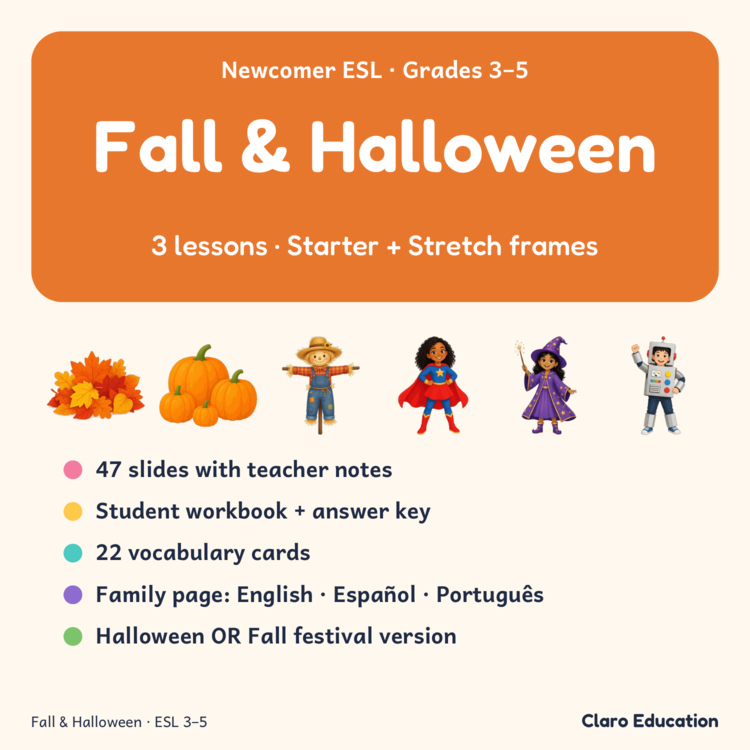
    My Fall & Halloween ESL Newcomer Lessons for Grades 3–5 has all three lessons: 47 slides with teacher notes on every slide, a teacher guide with grammar notes and an answer key, a student workbook with Stretch tasks, 22 vocabulary cards and a family page in English, Spanish and Portuguese. Nothing is scary.

    Cover of Fall and Halloween ESL Newcomer Lessons Grades 3–5 by Claro Education