English learners need writing practice that matches how they actually write right now, not a grade-level prompt with “use a dictionary” stapled on. The good news: one prompt can work for a whole class if you level the supports.
Level the supports, not the topic
Give everyone the same picture, chart or short source, then change the scaffolds:
Levels 1–2: a word bank, a picture for each step and a sentence frame to finish: “First, ___. Next, ___.”
Levels 3–4: a planning box and linking words (because, so, then).
Levels 5–6: a length goal and a challenge, like adding a counterclaim.
Everyone writes about the same thing, so you can still share and discuss as a class.
Score what matters with three questions
Instead of one overall grade, look at three things: Is the whole piece organized? (discourse) Are the sentences complete and varied? (sentence) Are the words precise? (word and phrase). Feedback gets much more specific, and students can see how to grow.
Hand students the rubric
“I can” rubrics in kid-friendly language (“I can use because to give a reason”) turn scoring into a goal. Students circle what they did, then pick one thing to try next time.
If you want it ready to go
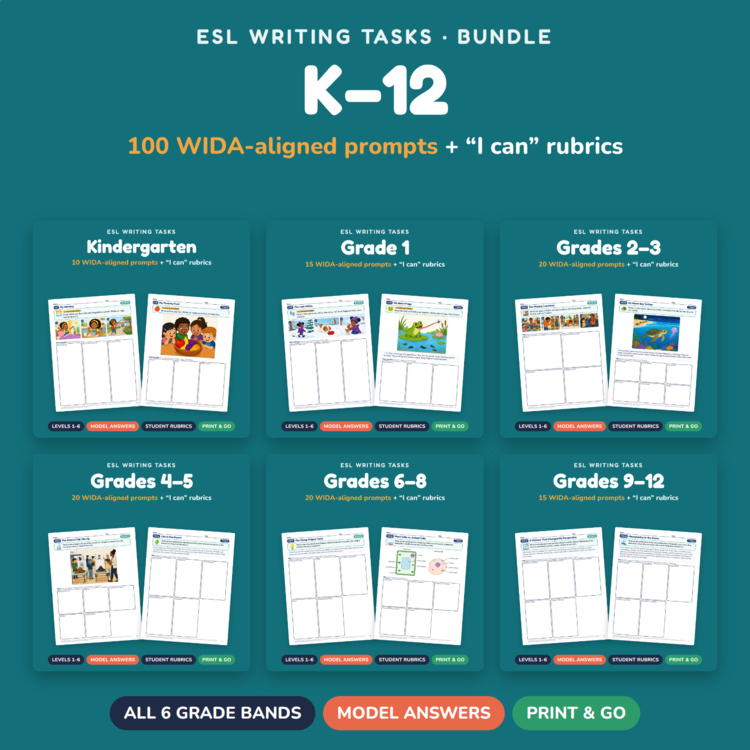
My ESL Writing Prompts K–12 Bundle has 100 original tasks across six grade-band packs (Kindergarten through Grades 9–12), with pictures, charts and short sources, leveled supports for Levels 1–2, 3–4 and 5–6, model answers, teacher pages and student “I can” writing and speaking rubrics. It’s aligned to WIDA’s six proficiency levels and the three dimensions of language (Discourse, Sentence, Word/Phrase), and a K–12 index helps you plan across grades.
Not affiliated with or endorsed by WIDA or the Wisconsin Center for Education Research. WIDA and ACCESS are trademarks of the Board of Regents of the University of Wisconsin System.
A new student just arrived, and they don’t speak English yet. They’re five, six or seven years old. Where do you start?
Start with what they need to belong: saying hello, saying their name, following a few class directions and knowing a class rule. That’s a full week, and it’s enough.
What to teach in Week 1
Day 1: Hello! “Hello! I am ___.” Wave, smile and say it again and again.
Day 2: What is your name? “What is your name?” / “My name is ___.” Pass a ball and ask around the circle.
Day 3: Listen and look. Sit down, stand up, listen, look. Play a quick game of “Simon says.”
Day 4: Our class rules. One rule, one picture, one sentence.
Day 5: Review and play. Students draw “All About Me” and trace “I am ___.”
Keep every lesson the same shape
Young newcomers relax when they know what’s coming. Use the same 6 steps every day: Hello circle, Picture talk, Say it!, Sounds and letters, Play and talk, My page. About 30 minutes is plenty.
Talk first, write later
Oral language comes first. Put sentence stems on every slide, with small pictures above the meaning words, so children who can’t read yet can still say the sentence. Kindergarten students listen for sounds and practice pre-writing strokes. Grades 1–2 start letters and short sentences.
Try a whole week free
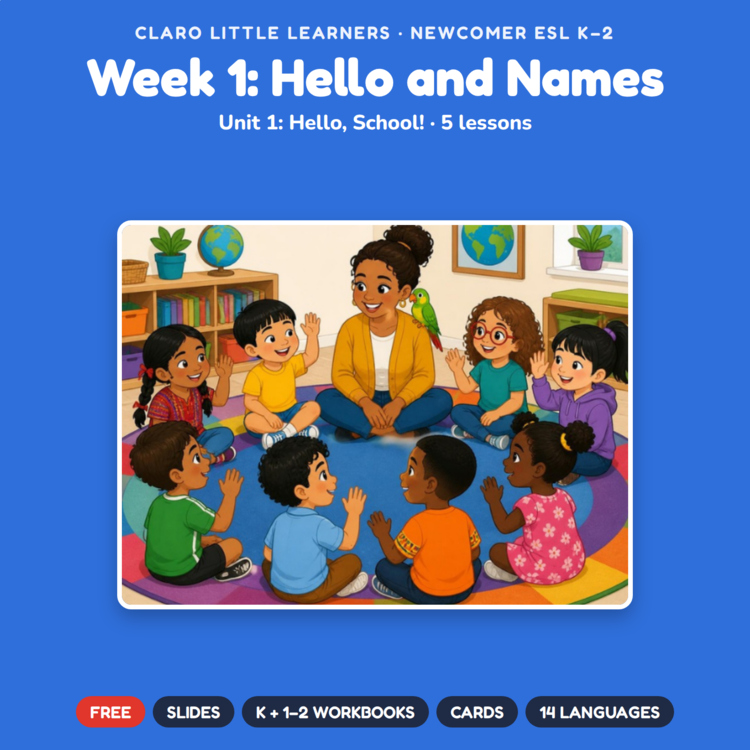
My FREE Newcomer ESL K–2 Week 1: Hello and Names has all five lessons: 86 slides with teacher talk in the speaker notes, a Kindergarten workbook, a Grades 1–2 workbook, picture cards, song posters, family pages in 14 languages and a teacher guide. If it works for you, Weeks 2–5 are in the Unit 1 bundle.
A classroom pet gives English learners something every lesson wants: a real reason to talk. When there’s a leopard gecko in the room, students want to say what it’s doing, ask questions and write about it.
Leopard geckos are calm, quiet and easy to care for, which is why many teachers choose them. (Check your school’s pet policy first, and always follow safety guidance: students should wash their hands and only hold the gecko with an adult’s help, sitting over a soft surface.)
3 ways to turn gecko care into language practice
1. Make the daily checklist a speaking routine. Assign classroom jobs (feeder, water checker, temperature reader) and give each job a sentence frame: “I checked the water. It is clean.” Picture-supported checklists let newcomers do a job from Day 1.
2. Keep an observation journal. Students write one sentence a day: “Today the gecko is ___.” Over time, push to longer sentences with because: “The gecko is hiding because it is sleepy.” It’s science writing that grows with them.
3. Teach structures and senses. Leopard geckos have feet with tiny claws instead of sticky toe pads, a tail that stores fat and big eyes for seeing in dim light. Students can name the body part, say what it does and explain it in a claim–evidence–reasoning paragraph.
Bring families in
A family letter in English and Spanish helps families know what’s happening, and a “name the gecko” class vote is a fun way to practice opinions: “I think we should name it ___ because ___.”
How I got my classroom gecko
I got my classroom gecko through Pets in the Classroom, and it was super easy to use. I got the terrarium and starter kit for free and 50% off the gecko, then supplemented with some of my own supplies. If you’ve been thinking about a classroom pet, it’s a great place to start.
If you want it ready to go
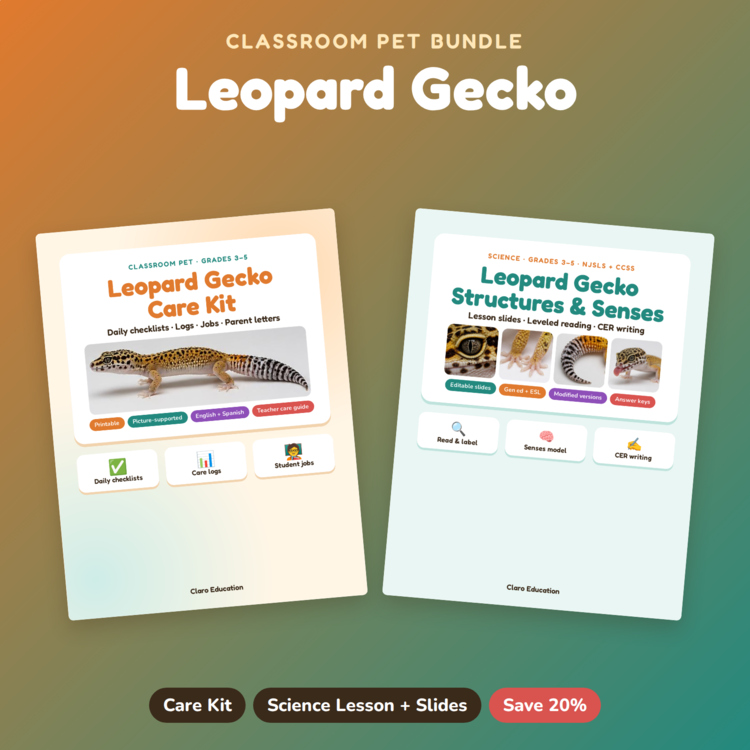
My Leopard Gecko Classroom Pet Bundle includes the 24-page Care Kit (checklists in standard, picture-supported and Spanish versions, logs, a job chart, rules posters, family letters, a holiday care plan, a name vote, an observation journal and certificates) and a Structures & Senses science lesson for grades 3–5 with a leveled reading, a diagram, a CER writing task and ESL-modified pages. It’s not veterinary advice, so talk to a vet about your pet’s care.
October is full of new words for our youngest English learners: leaves, pumpkins, costumes, “Trick or treat!” It’s a great time to teach them, as long as the lessons are short, visual and easy to adapt for families who don’t celebrate Halloween.
3 ideas for K–2 newcomers
1. Go on a fall picture walk. Show photos (or take a real walk) and name what you see: leaf, apple, pumpkin, tree, chipmunk, scarf. Kindergarten students point and say “I see a ___.” First and second graders stretch it: “In fall, I see a ___.”
2. Describe a real pumpkin. Bring one in. Teach big, small, round, orange, stem, seeds, then pass it around. “It is round.” “The pumpkin is big and orange.” Touching the real thing makes the words stick.
3. Have a dress-up day with friendly costumes. Teach cat, bat, owl, firefighter, doctor, astronaut and the question “Who are you?” / “I am a ___.” Add polite phrases like “Thank you!” and “No, thank you.” If your school doesn’t do Halloween, call it a Fall Festival. The words are the same.
Two tracks, one lesson
Teach the whole group together, then split the practice: Kindergarten traces, circles and draws, while Grades 1–2 match, sort and write sentences. Everyone learns the same words at the same time.
If you want it ready to go
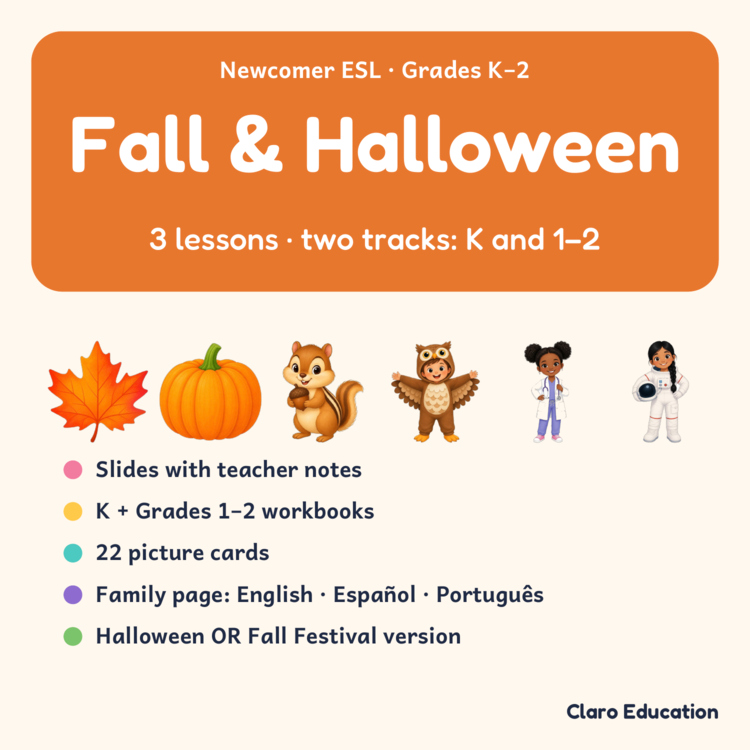
My Fall & Halloween ESL Newcomer Lessons K–2 pack has all three lessons: slides with teacher notes on every slide, a Kindergarten workbook, a Grades 1–2 workbook, 22 picture cards, a teacher guide and a family page in English, Spanish and Portuguese. Lesson 3 includes both a Halloween role-play and a Fall Festival role-play, and nothing is scary.
Veterans Day is Wednesday, November 11. It’s a lovely holiday for English learners: the vocabulary is concrete (veteran, service, thank you, poppy), the history is short, and the main activity, writing a thank-you card, gives every student a real reason to write in English.
It also needs a little care. Some of our students have lived through war, or have family members who serve in other countries’ militaries. Here is how to keep the lesson warm, honest and safe.
Keep the focus on service, thanks and peace
Teach what Veterans Day is (a day to thank people who served in the U.S. military) and why it’s on November 11 (the fighting in World War I stopped on November 11, 1918). Skip combat images and battle details. Students don’t need them to understand the day.
3 ideas you can use this week
1. Pre-teach 8–10 words with pictures.Veteran, serve, military, flag, parade, poppy, remember, thank, peace. Show a picture, say the word, have students repeat it and use it in a sentence: “A veteran served in the military.”
2. Connect to remembrance around the world. Many countries remember on November 11. In the U.K. and Canada it’s Remembrance Day, and people wear red poppies. Ask: “Does your country have a day to remember? What do people do?” Give a frame: “In ___, people ___.”
3. Write thank-you cards at every level. Levels 1–2 copy and complete: “Thank you for your ___.” Levels 3–4 add a reason: “Thank you for ___ because ___.” Levels 5–6 write a short friendly letter. Ask your school office whether a local veterans group would like to receive the cards.
If you want it ready to go
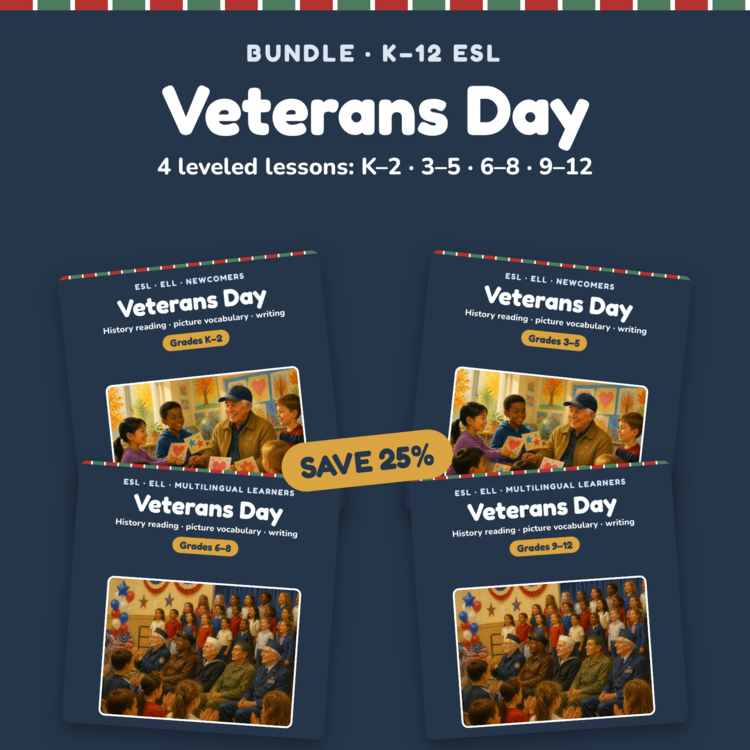
I wrote Veterans Day ESL lessons for four grade bands (K–2, 3–5, 6–8 and 9–12). Each one has a reading written for that age, picture vocabulary, a newcomer reading for Levels 1–2, comprehension questions with a key, a Remembering Around the World page, printable thank-you cards, writing frames for every level, lesson slides and a Google Slides version. The teacher guide includes notes for students who have lived through war.
Every November, my English learners come to me with a version of Thanksgiving they picked up somewhere: a cartoon, a coloring page, a hallway bulletin board. Usually it’s a happy meal, some paper feather headbands, and nothing before or after.
Our students deserve better than that. Many of them are new to this country, and many come from places where history is complicated and people remember it differently. They are often very ready for an honest story. They just need it in English they can understand.
Here is how I teach Thanksgiving history to ELLs at every level, and a few things you can try this week without buying anything.
Start with the Wampanoag, not the Mayflower
Most versions of the story begin in 1620 with a ship. That makes the Wampanoag guest stars in their own homeland.
So start earlier. The Wampanoag have lived in what is now southeastern Massachusetts and Rhode Island for thousands of years. They farmed, fished, hunted, and moved with the seasons. They grew corn, beans, and squash together (the “Three Sisters”), and giving thanks for the harvest was already part of their life long before 1621.
And then say this sentence out loud: the Wampanoag are a living Nation today. Two Wampanoag Tribes are federally recognized: the Mashpee Wampanoag Tribe and the Wampanoag Tribe of Gay Head (Aquinnah). Students should leave your class knowing that Native people are not only people of the past.
Tell what happened, using a real source
Here is the short version I give students, adjusted for each grade level:
1616–1619: A disease brought by Europeans killed most of the Wampanoag people in the area. The village of Patuxet was almost empty.
1620: About 102 English passengers arrived on the Mayflower and built Plymouth where Patuxet had been. About half of them died that first winter.
March 1621: The Wampanoag leader Ousamequin (also called Massasoit) made an alliance with the colonists. Tisquantum (Squanto), a Patuxet man who had been kidnapped and taken to Europe years before, spoke English and helped them.
Fall 1621: After the harvest, about 90 Wampanoag men came to Plymouth with Ousamequin. They brought five deer. The gathering lasted about three days.
How do we know? Edward Winslow wrote about it in a letter in December 1621. It is one of the only sources we have. With older students, read a short, simplified piece of that letter together. Primary sources make the point better than a lecture: we know some things, and the colonists didn’t call it “Thanksgiving.”
For middle and high school students, keep going. Thanksgiving didn’t become a national holiday until 1863 (Lincoln, after Sarah Josepha Hale’s long letter campaign), and Congress set the fourth Thursday in 1941. The peace of 1621 did not last: King Philip’s War (1675–1676) was led by Metacom, Ousamequin’s son. And since 1970, many Native people have gathered in Plymouth on Thanksgiving Day for a National Day of Mourning. Teens can handle these perspectives, and they often have the most to say.
4 tips you can use this week
1. Pre-teach 8–12 words with pictures. Choose words like harvest, Wampanoag, colony, Pilgrims, feast, crops, tradition, thankful. Show one picture per word, say it, have students repeat it, then use it in a short sentence: “The Wampanoag grew corn.” Put the words on the wall for the whole week.
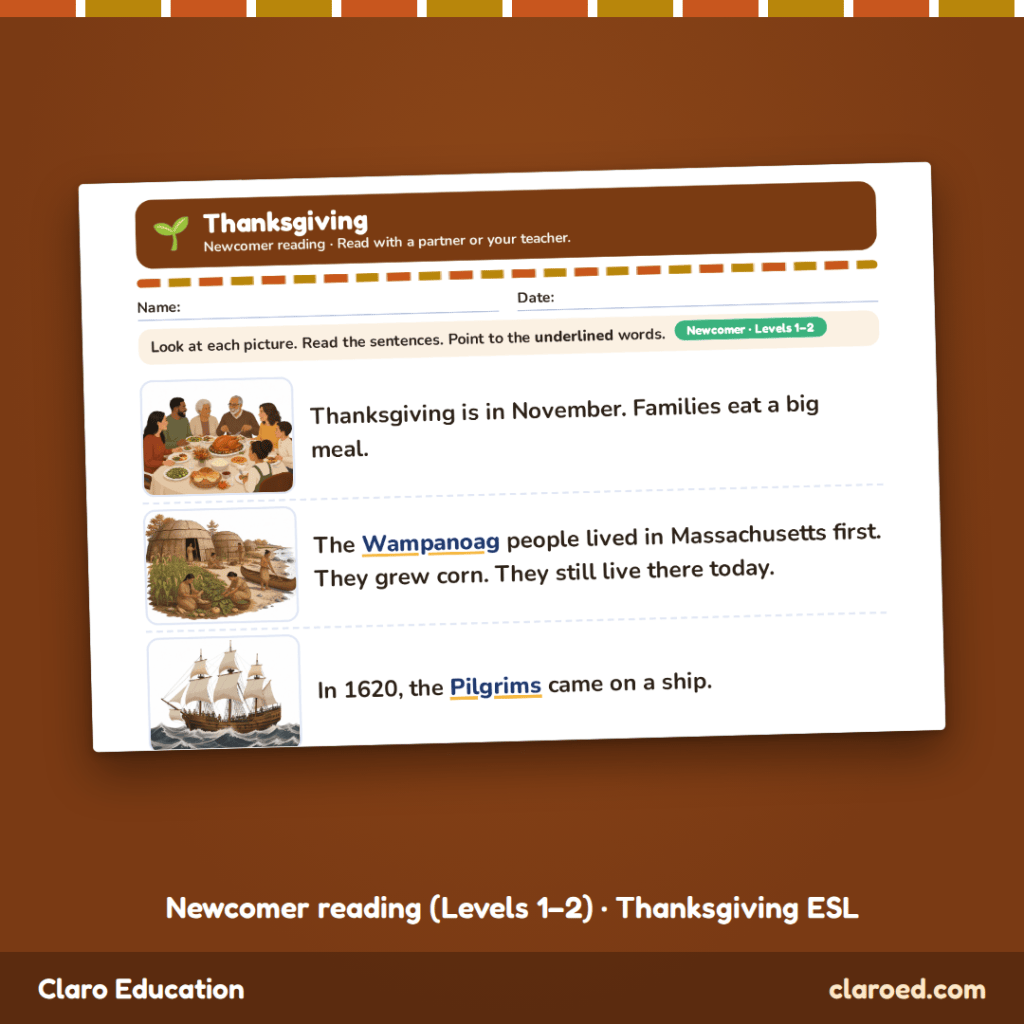
2. Give newcomers the same history in shorter sentences. Don’t send newcomers to a coloring page while the class learns history. Write five or six short sentences, each with a picture: “The Wampanoag lived here first. In 1620, the Pilgrims came on a ship. The first winter was hard. The Wampanoag helped them grow corn. In 1621, they ate together for three days.” Underline the key words. Newcomers can point, repeat, and answer yes/no questions while the rest of the class reads the longer text.
A newcomer reading for Levels 1–2 from the Grades 3–5 lesson.
3. Skip the costumes and role-plays. No paper headbands, no “Pilgrims and Indians” dress-up, no acting out Native people. Use real images and real names instead. This is easy to change, and it matters a lot to Native families.
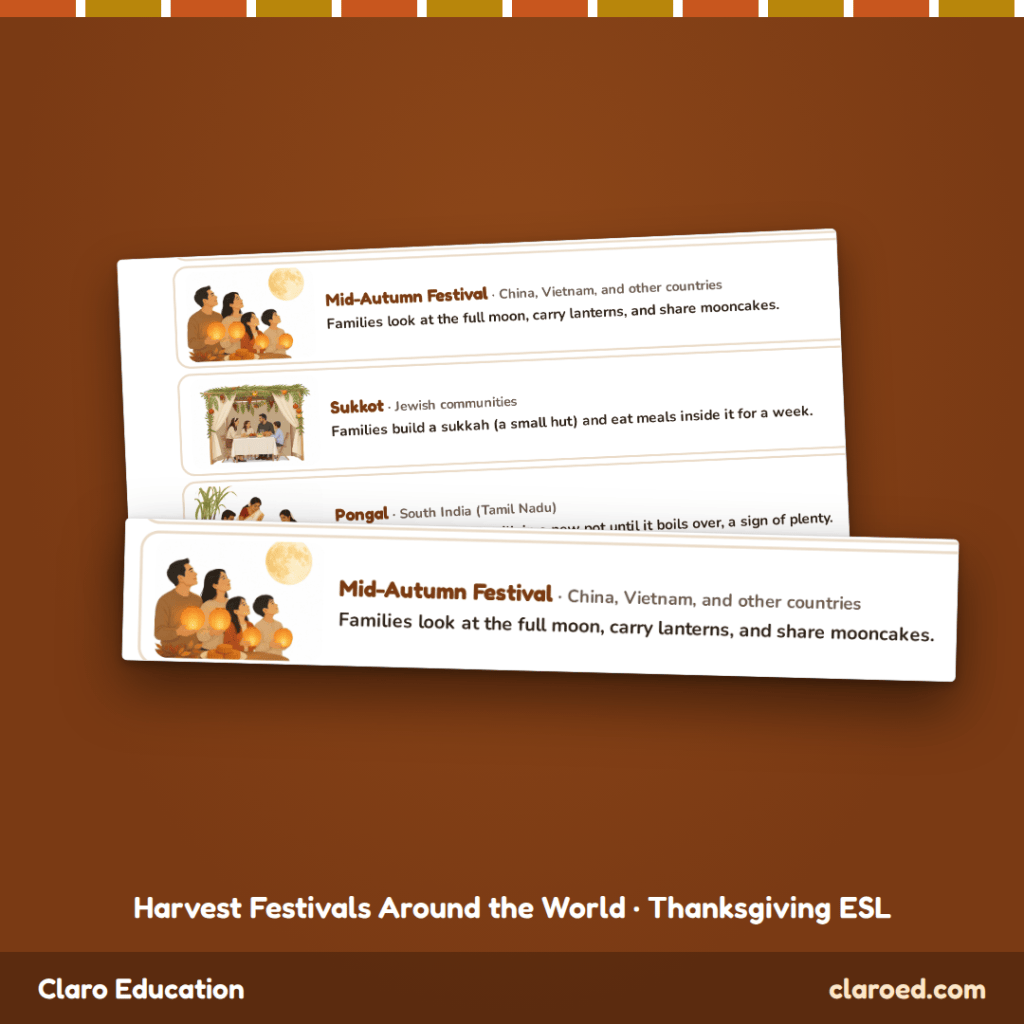
4. Connect to harvest festivals students already know. Many cultures give thanks for the harvest: Chuseok in Korea, the Mid-Autumn Festival in China and Vietnam, Pongal in South India, Sukkot in Jewish tradition, and New Yam Festivals in West Africa. Ask: “Does your family have a harvest holiday? What do you do?” Students who’ve been quiet all week will often light up here. Give them a frame: “In my family, we celebrate ___. We ___.”
The Harvest Festivals Around the World page.
End with gratitude, carefully
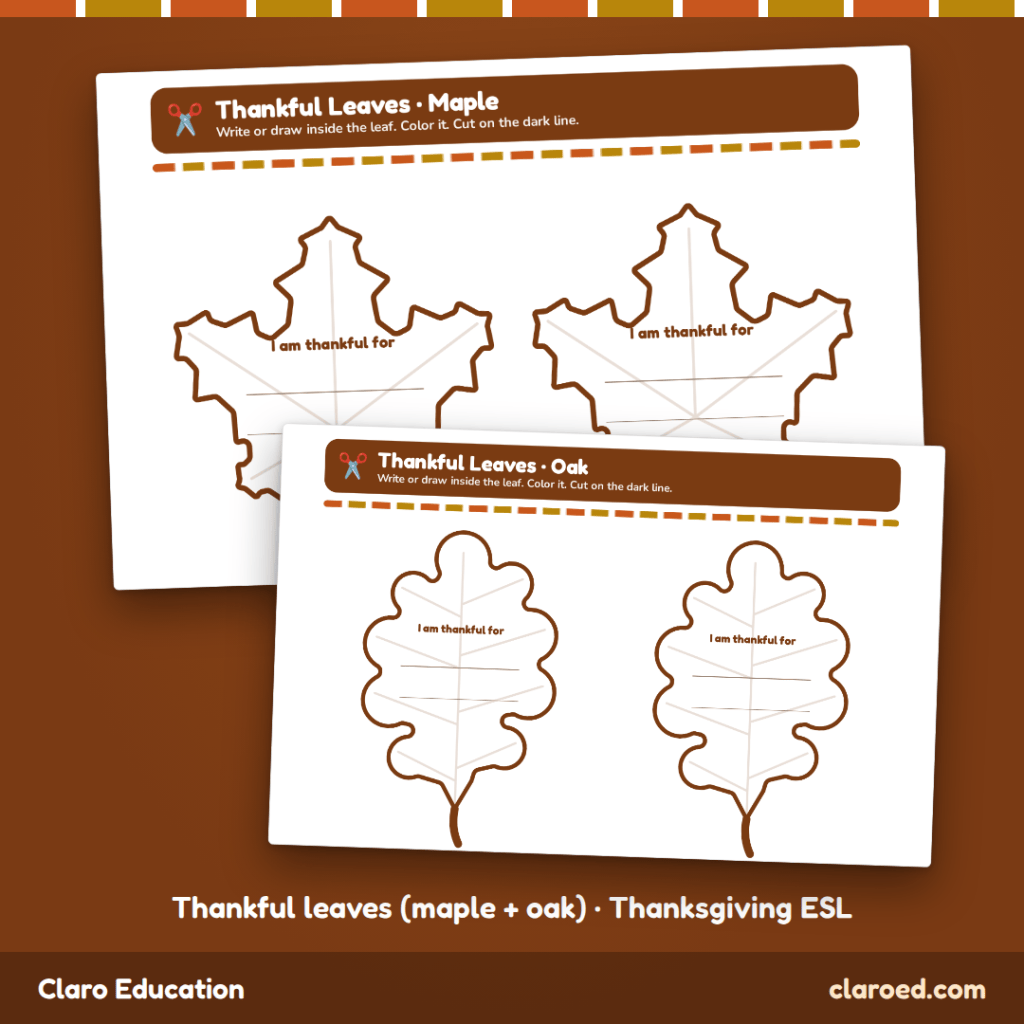
I like to close the week with a class Thankful Tree. Each student writes “I am thankful for ___ because ___” on a paper leaf, reads it aloud, and tapes it to a tree on the wall. Newcomers can draw and label one word. That counts.
Maple and oak Thankful Leaves: write or draw, color, cut and add to the tree.
Two cautions. Keep “thankful” open: people, places, things, ideas. Don’t ask what or how much students will eat. And let anyone pass. Some of our students have lost a home, a country, or a family member, and this can be a hard question. Some families don’t celebrate Thanksgiving at all, and for many Native people it’s a day of mourning. Make every way of feeling about the day welcome.
If you want it ready to go
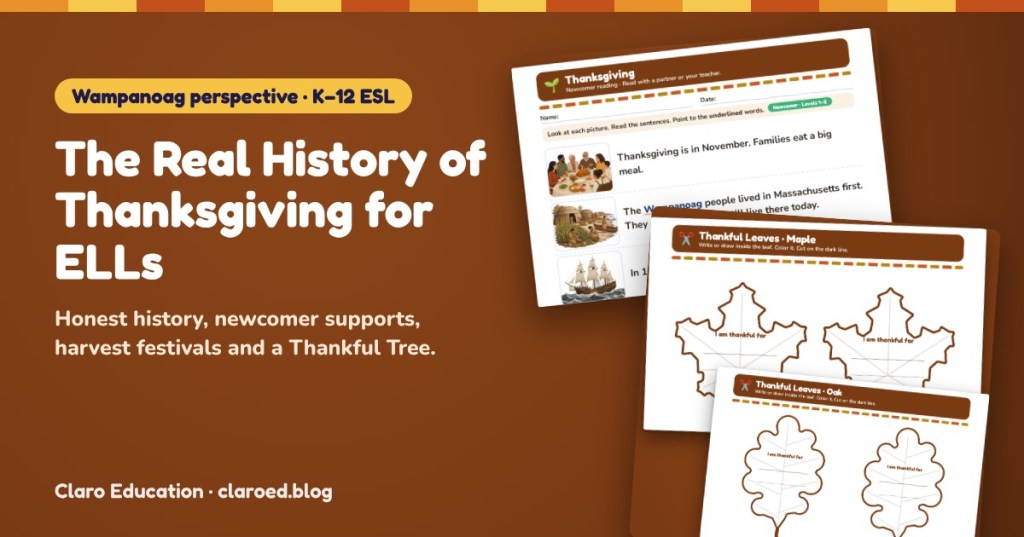
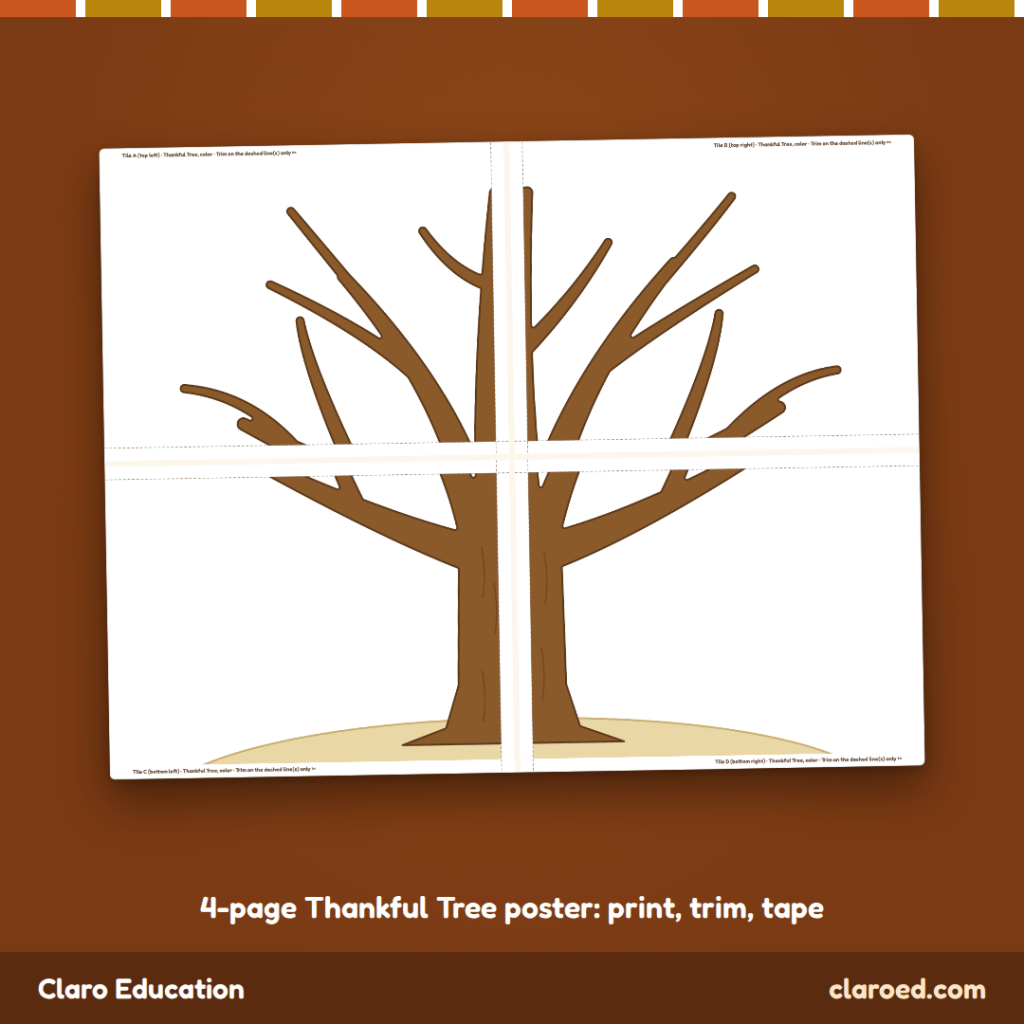
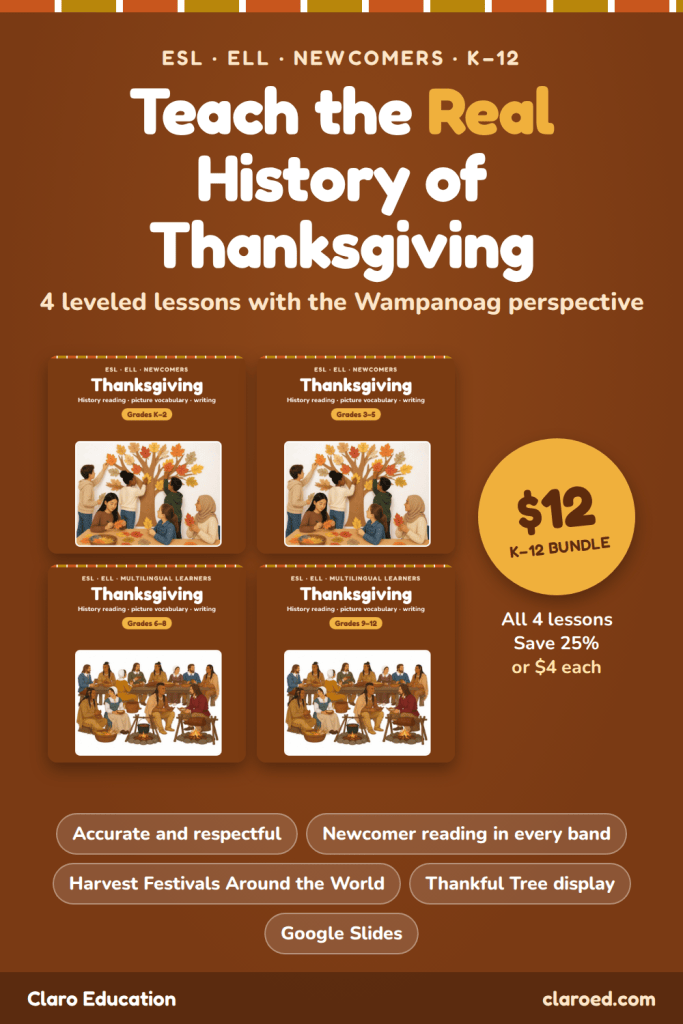
I put all of this into Thanksgiving History ESL lessons for four grade bands. Each one has a leveled reading with the Wampanoag perspective, picture vocabulary, a newcomer reading for Levels 1–2, comprehension questions with a key, a Harvest Festivals Around the World page, writing frames for every level, lesson slides with teacher talk, and a Google Slides version. Every lesson also includes the Thankful Tree display: a 4-page printable tree poster, maple and oak leaves, and a “We Are Thankful” banner.
The 4-page Thankful Tree poster comes with every lesson.
Election Day is Tuesday, November 3, 2026. It’s a midterm year, so you won’t hear about a presidential race, but your students will still see signs, ads, and lines at the polling place. Many of them will have questions.
For English learners, Election Day is a great lesson. The vocabulary is concrete (ballot, vote, count), the history has a clear story, and a class vote gives every student, including your newest newcomer, a real reason to speak.
It can also feel risky. Here is how I teach it so it stays useful, safe, and completely nonpartisan.
First, set the ground rules (for you)
Before you plan anything, decide on these four things:
No parties, no candidates. We learn how voting works, not who to vote for.
Never ask how families vote. Don’t ask whether family members can vote, either. Some students’ parents can’t vote yet because of age or citizenship, and immigration status is never a classroom question.
Everyone votes in our class. I say it out loud: “Everyone can learn about elections, and everyone votes in our class vote.”
Let students choose whether to share. Elections look different around the world, and some students may have hard memories connected to them. Invite stories about home countries, but don’t require them.
The history: why a Tuesday in November?
This is the hook, and kids and teens love it because the answer is surprising.
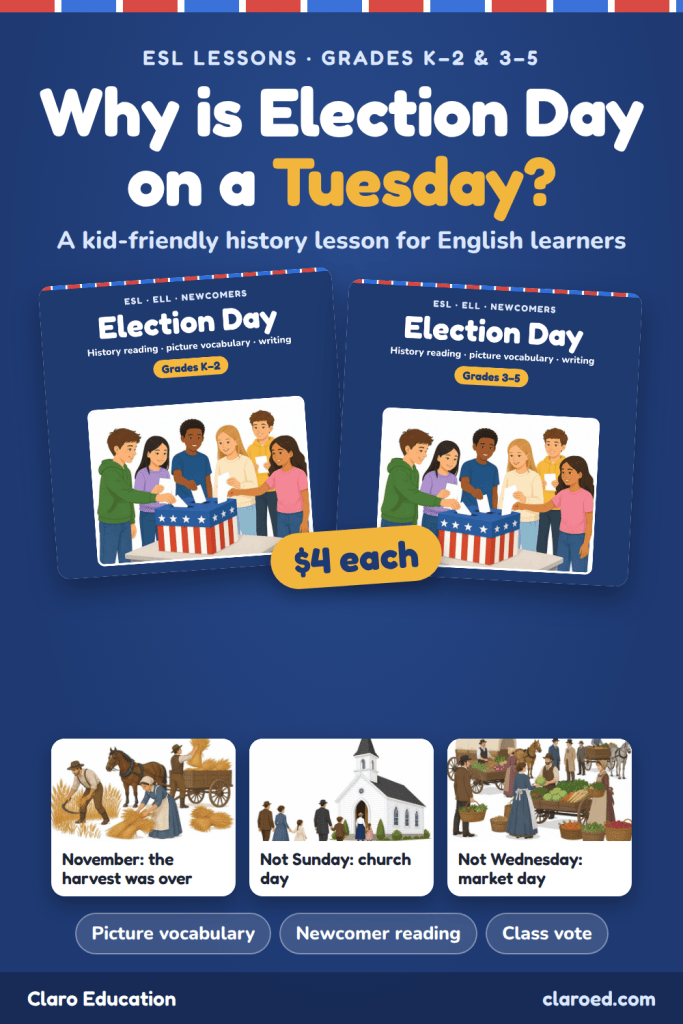
In 1845, Congress passed a law that set one day across the country for choosing presidential electors (in other words, for presidential elections): the Tuesday after the first Monday in November. Other federal elections followed later. In 1872, Congress moved House elections to the same day (starting in 1876), and Senate elections joined in 1914, after the 17th Amendment. Historians usually explain the choice of day like this:
November: Most Americans were farmers. By November the harvest was over, and winter hadn’t started yet, so roads were still open.
Not Sunday: Many people would not travel on Sunday, their day of rest and church.
Not Wednesday: Wednesday was market day in many towns.
Tuesday: Voters often had to travel a long way, sometimes a whole day, to the county seat. Tuesday gave them Monday to travel without missing church or market.
With younger students, keep it to two ideas: Election Day is in November because the farm work was done, and it’s on a Tuesday because people did not travel on Sunday and Wednesday was market day. With middle and high school students, add the 1872 law for House elections and the amendments that expanded the right to vote: the 15th (1870), the 19th (1920), and the 26th (1971, age 18), plus the Voting Rights Act of 1965.
A simple lesson plan (about 60 minutes)
Warm-up (5 min). Show a picture of people waiting in line to vote. Ask: “What are these people doing? Where are they? Why are they waiting?” Give a frame: “I think they are ___ because ___.”
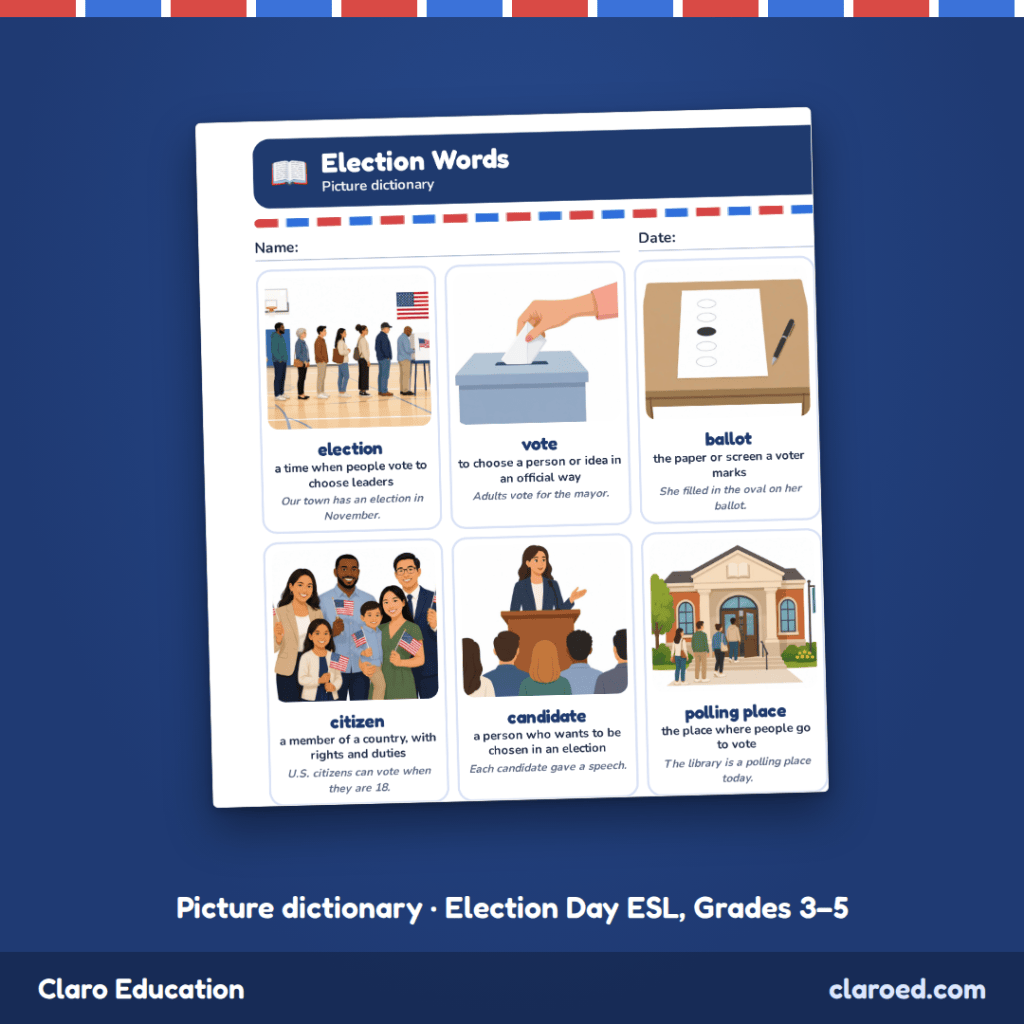
Vocabulary (10 min). Teach 8–12 words with one picture each: election, vote, ballot, voter, citizen, candidate, polling place, register. Students repeat the word, then say a sentence with a partner.
The Election Words picture dictionary from the Grades 3–5 lesson.
Read (15 min). Read a short history text aloud first, then have partners reread. Stop and ask “Why?” at each reason: Why November? Why Tuesday?
Class vote (5–10 min). See below.
Write (15 min). Students explain why Election Day is a Tuesday in November using frames for their level. Levels 1–2: “Election Day is in ___. It is on a ___.” Levels 3–4: “Election Day is in November because ___.” Level 5: explain two reasons and add an example.
4 tips you can use tomorrow
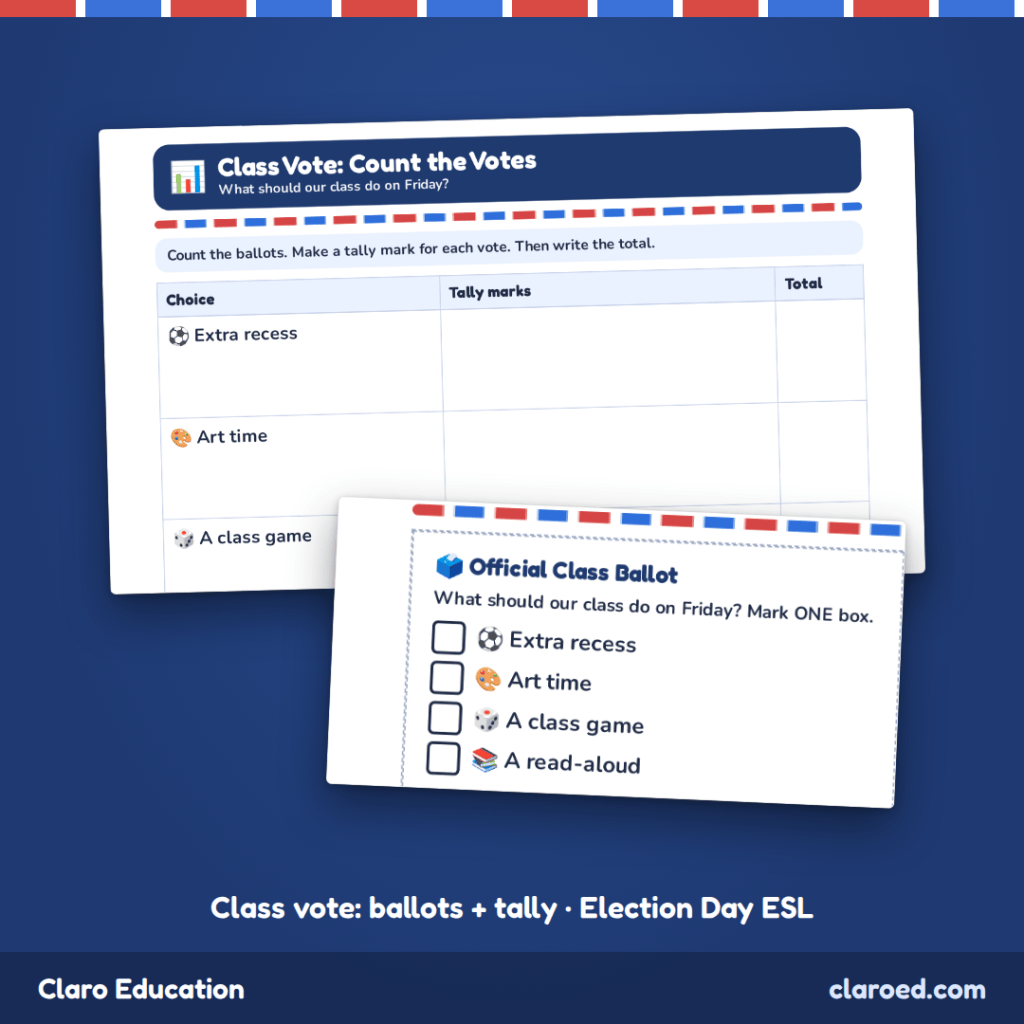
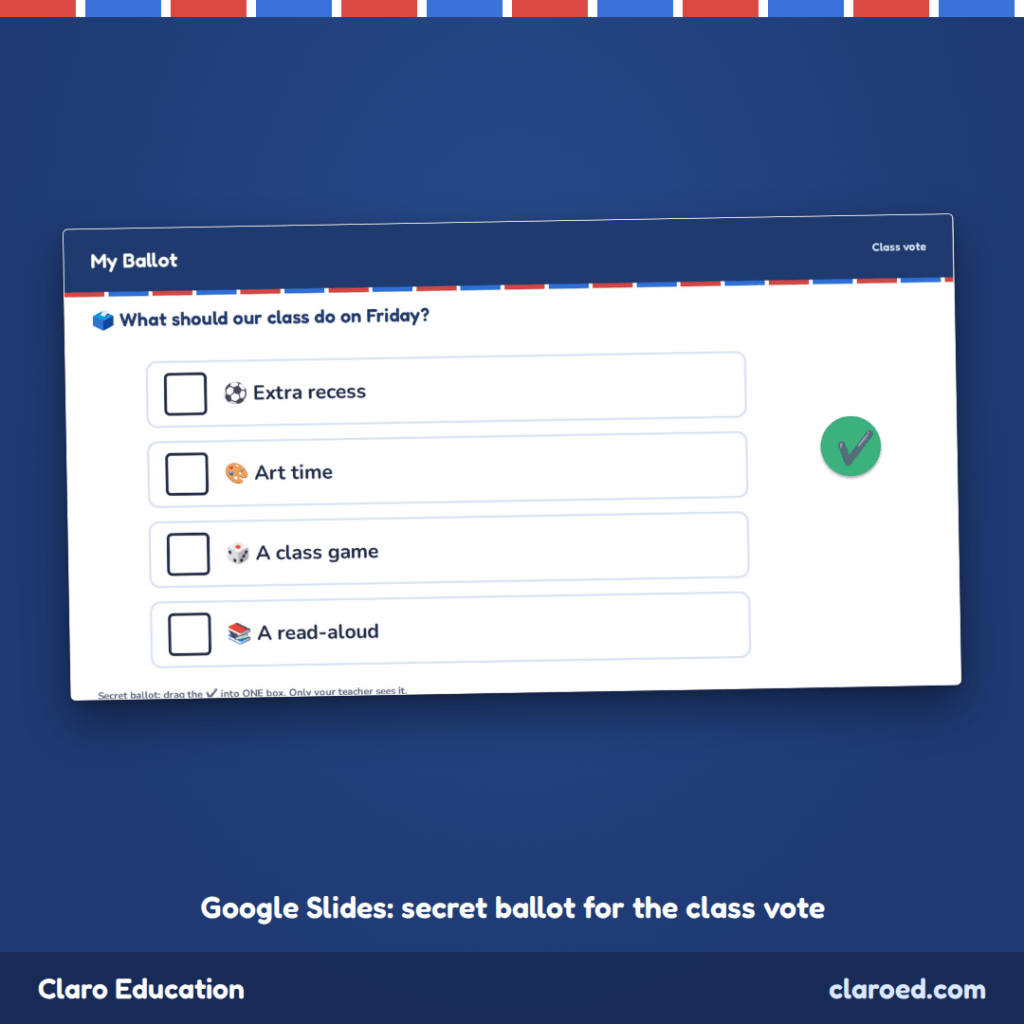
1. Hold a real secret-ballot class vote. Choose a class decision: extra recess, art time, a class game, or a read-aloud. Make small paper ballots with pictures next to each choice. Students vote privately, fold the ballot, and drop it in a box (a tissue box works). Two volunteers count with tally marks. Finish with a frame: “The winner is ___. It got ___ votes.” Then ask: “Why do we use a secret ballot?”
Printable class ballots and a tally sheet are in every grade band.
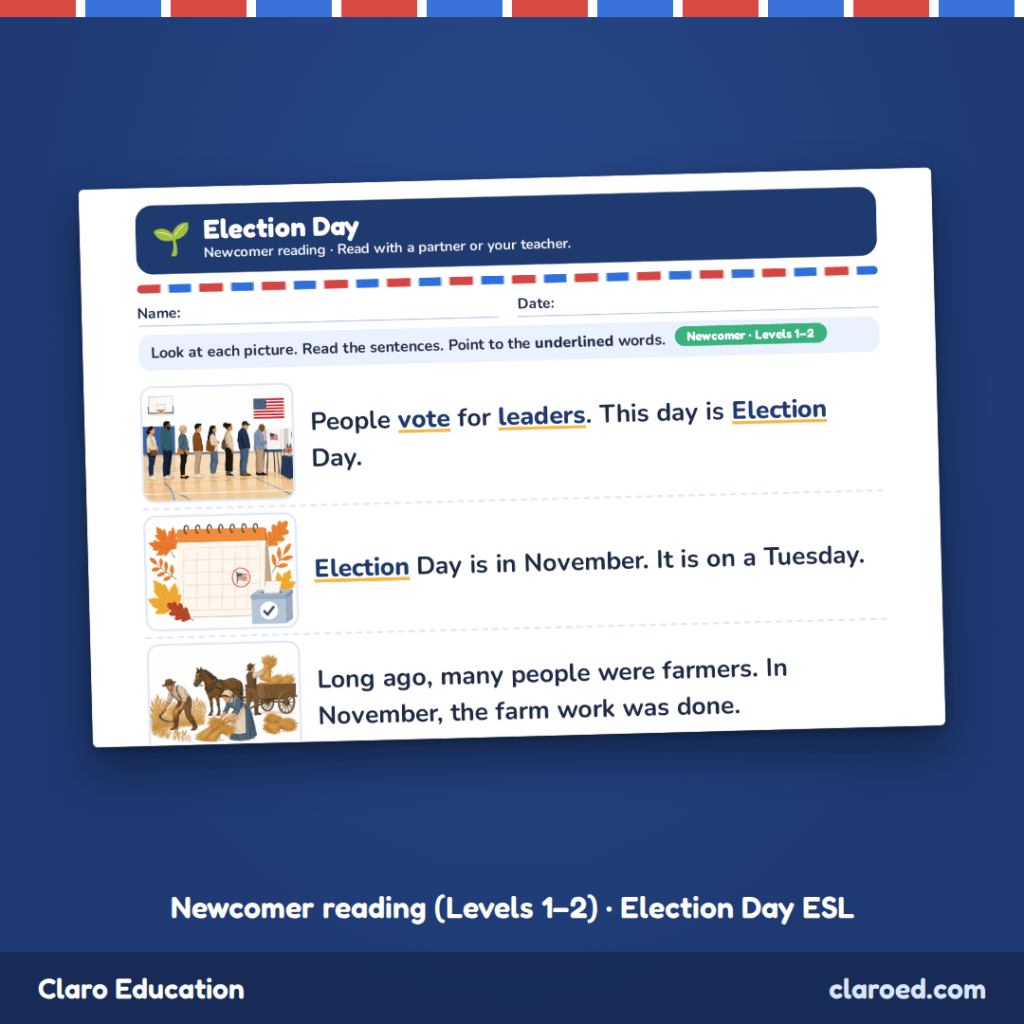
2. Give newcomers the same topic in short sentences. Newcomers can learn this content too. Write six short sentences with a picture each: “People vote for leaders. Election Day is in November. It is on a Tuesday. Long ago, many people were farmers. Today, people vote at a school or a library. They mark a ballot.” Underline the key words. Newcomers point, repeat, and then join the same class vote.
A newcomer reading for Levels 1–2: one short sentence and one picture per idea.
3. Use “because” as your language goal. The whole lesson is about reasons, so it’s a natural place to practice because. Post the frame where everyone can see it and point to it every time a student gives a reason.
4. Make a timeline for older students. Teens can put 1845, 1870, 1872, 1920, 1965, and 1971 on a timeline and write one cause-and-effect sentence for each date. For argument writing, keep the question historical: “Was a Tuesday in November a good choice for voters in 1845?” Students give a claim, two reasons from the reading, and a counterclaim (for example, “Some voters still had to travel a long way.”).
If you want it ready to go
I made Election Day ESL lessons for four grade bands, each with a leveled history reading, picture vocabulary, a newcomer reading for Levels 1–2, comprehension questions with a key, writing frames for every level, printable class ballots and a tally sheet, lesson slides with teacher talk in the speaker notes, and a Google Slides student version. The teacher guide includes notes for keeping the lesson safe and nonpartisan.
The Google Slides student version includes a secret-ballot class vote.
Grades K–2 ($4): an 80-word read-aloud, 8 picture words, draw and write about the class vote
Grades 3–5 ($4): why Election Day is a Tuesday in November, 10 words, explain the reasons in writing
Grades 6–8 ($4): the 1845 law, the farmers’ calendar, and the amendments; cause and effect
Grades 9–12 ($4): from 1845 to the secret ballot and the Voting Rights Act; argument writing
Whatever you use, don’t skip the class vote. Counting ballots out loud gives even your quietest newcomer a real reason to say numbers and words in English, and it shows every student how a fair vote works.
Save this for later: pin it to your Election Day board.
Facts in this post were checked with Congressional Research Service reports and Ballotpedia.
If you’ve watched a newcomer sit down for ACCESS, whether they’re 6 or 16, you’ve probably seen it: the tight grip on the pencil, the eyes on you instead of the screen. Most of these students know more English than they think. What they don’t know is what’s about to happen.
That’s the part we can fix. English learners do better when the test feels familiar: they know what the screen or booklet will look like, what kinds of questions come, and that it’s okay not to know every answer.
That’s why I’m a big believer in practicing test-style items all year long, not just in the few weeks before testing. To be clear, this isn’t teaching to the test. That’s never the goal. But our ESL students shouldn’t be surprised when they sit down for ACCESS. When the question types already feel familiar, kids stop worrying about the format and get to do what they came to do: show off the language skills they’ve worked so hard to build.
Here’s what ACCESS looks like at each grade, what each part asks students to do, and a few calm-down habits you can start this fall.
What ACCESS looks like, grade by grade
The biggest changes happen between kindergarten and first grade, and again at fourth grade, when Writing moves from paper to the keyboard. Here’s the standard online version for each grade band.
Grade
How it’s given
What students do
Practice it
Kindergarten
On paper, one-on-one with a trained test administrator
The adult reads everything aloud and records the child’s answers. There are built-in stopping points along the way.
The online test adapts. Students move to easier or more challenging questions based on how they’re doing, so no two students see exactly the same test.
Some districts give the whole test on paper, and some states allow handwritten Writing in grades 4–12. Ask your test coordinator which version your students will take.
WIDA posts free official sample items and online test demos for each grade band. Showing your class the demo on the big screen a few times before test day does a lot to take the mystery out of it.
Testing windows differ by state, so check your dates with your district.
The four parts, in kid-friendly words
A simple way to explain ACCESS to students, especially younger ones, is as four jobs. Giving each one a simple name and a motion makes it less scary.
Listening: “ears.” You hear something and choose the answer that matches.
Reading: “eyes.” You read and show what it means.
Speaking: “mouth.” You answer out loud. Short answers are okay, and longer ones are even better.
Writing: “pencil” (or keyboard). You write your ideas. Every word you write shows what you know.
The message for every part is the same: try your best, then keep going. Nobody knows every answer, and that’s built into the test.
Calm-test-nerves habits to start now
None of these take more than five minutes, and they work best when they start months before the test.
Practice the routine, not just the skills. Set up a few “test-style” mornings: desks apart, quiet voices, headphones on. When the real day looks like a practice day, it’s just another morning.
Use a speaking ladder. Teach students to climb from a 1-word answer to a 3-word answer to a full sentence of 5 or more words (“dog” → “a big dog” → “I see a big brown dog”). It gives them a plan when they’re asked to talk.
Practice talking into a headset. From grade 1 up, Speaking answers are recorded. Let students practice speaking to a microphone so it doesn’t feel strange on test day.
Build keyboarding early. Students start typing their Writing in grade 4. A few minutes of typing practice each week makes a real difference.
Teach a “stuck” plan. Out loud, together: “I don’t know. I take a breath. I pick my best answer. I keep going.”
Name the feeling. Let students point to how they feel before a practice session (calm, worried, excited). Anxious kids relax when the feeling has a name and a place to go.
Bring families in. A short note home in the family’s language explaining what ACCESS is, and that it’s not a pass/fail test for their child, takes pressure off at home too.
Watch the demo together. Use WIDA’s free online test demo so the screens are familiar before test day.
Want it ready to go?
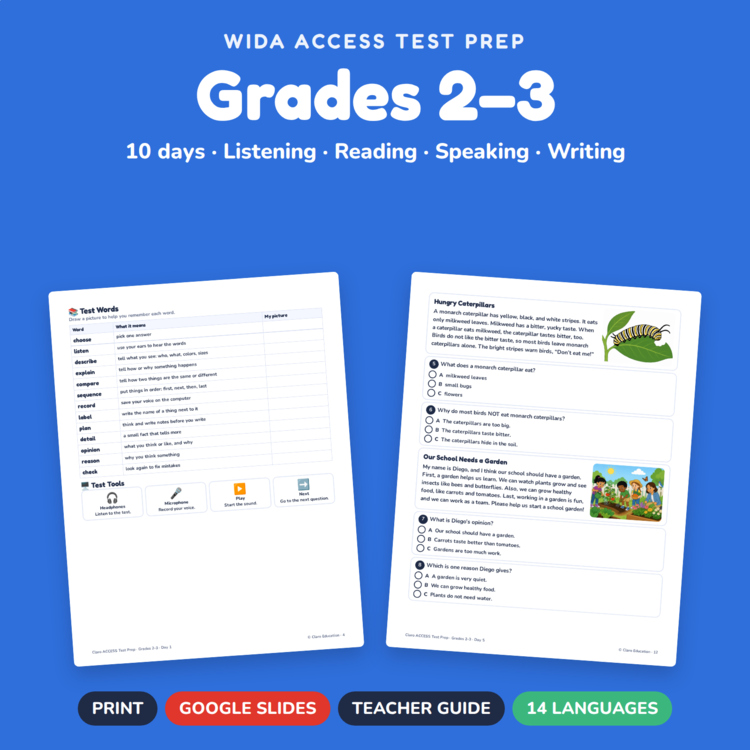
Start free: my FREE WIDA ACCESS Test Prep Sampler (K–12) is 18 real pages from all six grade-band units (K, 1, 2–3, 4–5, 6–8 and 9–12), covering all four parts: Listening, Reading, Speaking and Writing. It even includes writing models at Levels 1, 3 and 5, so you can try it with your students before you buy anything.
Each full unit is 10 days of short daily practice in all four parts, with prompts you read aloud, a calm-test-nerves page, the 1–3–5 speaking ladder, and family kits in 14 languages. They work on paper or in Google Slides with self-grading Google Forms.
Whatever you use, start early and keep it going all year. The goal isn’t a perfect score. It’s a confident kid who walks in, knows what to expect, and shows off everything they can do in English.
Happy (calm) testing, Veronica
Not affiliated with or endorsed by WIDA or the Wisconsin Center for Education Research. WIDA and ACCESS are trademarks of the Board of Regents of the University of Wisconsin System.